Where is the Idea of a Recording Studio Headed?
Perhaps a musically existential start to 2026, but I had a friend recently ask me what the value in studio recording is when home recording exists. Which, on the surface seems simple - good spaces, equipment, an engineer - but realistically is a very valid question when on paper, home recording seems a much better long term investment.
I think for now - the concise answer is that recording costs are more prohibitive these days, especially for bands, and with the advent of home recording, the role of the music studio has changed. Most of the time, a professional sounding recording can be achieved at demo stage, with any DAW. For example, a studio is advantageous for recording drums - especially if paying for a good acoustic space to record in, but direct recording can be achieved at home for synthesisers, bass, guitars even - especially with the existence of modelling amps. With a little effort, and treatment, even vocals can be recorded at home. And what about the cost? Well - everything you’re paying for your will own, and have no time or rental pressures. With any luck, the final cost of recording an E.P can simply be the mix and master.
You can trace the transition from studio to home studios slowly - if we go back to The Beatles, they recorded at Abbey Road for free because EMI owned the studio, and they were of course one of EMI’s recording artists. Imagine Studio 2 being your office - pretty good right? Aside from actually being The Beatles, having carte blanche access to any equipment, facilities, and time must have been quite convenient (I suppose this is an understatement) - but at the same time, the studio had to be the space for writing and recording. Beyond the stage and the rehearsal room, the live room was the sole place for new songs to be written, worked upon, recorded, and mixed. Fast forward a little, Pink Floyd’s Dark Side of the Moon (1973) was recorded across 6 months in Abbey Road’s Studio 3, with breaks for touring and other commitments. The album was developed on tour, before being fully realised in the studio with the availabilities of new technologies. In this instance, studio time could be spent on experimentation. Fast forward again to 1997/8, if you watch Radiohead’s ‘Meeting People Is Easy’ you’ll note a five minute excerpt captured across a day in Abbey Road’s Studio 2, culminating in Thom Yorke’s frustrated assessment of the day’s challenges:
‘We’ve been actually working all day and the only thing we’ve got that’s any good is the bass and the guitar.’
(Meeting People is Easy - clip here)
This isn’t necessarily a point of comparison as one artist’s approval of their work can vary massively, but there is definitely a shift in attitude towards studio time. The disappointment with just ‘bass and guitar’ as a day’s work demonstrates the heightened pressure of studio time being a highly productive and organised environment for the working artist. By this point, the opportunity to record in a major studio seems to point towards having the full arrangement and performance of a song worked out well in advance - something that admittedly, is always a great approach to any studio time nowadays, given there are always unforeseen bumps along the way.
So these days it’s hard to find many music interviews where budgets or studio challenges aren’t a prominent talking point. It’s evident that streaming has completely rearranged the sales model for music - which is it’s own can of worms, but artist’s recording budgets, especially without labels, are mostly determined by their own wallets - even touring can pose a financial loss even if it grows a fanbase considerably. This isn’t the focus of my thoughts for today but is definitely its own issue worth discussing. What is perhaps a silver lining is that home recording is now (relatively) inexpensive and accessible. It’s not uncommon to hear of modern pop artists reporting that all of their songs began with their producer in a bedroom sized space, often building a melody or rhythm track within software. Only then do they record in studios (if needed) to capture the full composition - such as orchestral sections, full-band tracking, or select vocal tracks. With the wonders of direct recording, you can arrive at a studio with 80% of the track already recorded. So I think it’s safe to say that the role of the studio has changed - not beyond its original purpose, but the recognition of a studio as the sole place to record is much less prevalent. In fact, studios are now almost boutique - surviving for their analogue equipment, the sound of their live space, or the knowledge of their engineers. The studio is perhaps now a space to fast-track your recordings to be immediately professional, as opposed to a reliance upon audio correction software - all of which is equally valid if it is more accessible, after all, it’s the art that counts.
Studios perhaps offer a seal of authenticity and a quality guarantee to a recording. For example, the constant innovation of phone cameras offer pristine photo quality to everyone - you can now photograph your cat in however many megapixels you like - but funnily enough they don’t make you a better photographer, they just give you the access to the means of photography. So with this thinking, the studio still is very important - and I think this is where I lie. I know that if I am approached to record, by a band, I can have a confidence that I will be able to help them realise their composition into a finished track - having access to a studio will only make this easier and guarantee those results with less effort. So the studio is less essential, but still the best option - budget allowing, it would just seem that the hierarchy of recording has become flatter. At the same time, it seems the hierarchy of artists to labels, audiences, and streaming platforms is more complicated than ever.
From a mixing perspective, access to plugins has become a wider and cheaper market. The home studio is evidently the place to be from the perspective of software developers - take Universal Audio as an example, their plugins have moved away from hardware reliance (DSP) and are now constantly marketed towards artists, creators, amateurs, and professionals - with endless sales and new products. My most recent favourite is the UAD Oceanway Studios plugin - I can take a flat vocal (say recorded on an EV RE20) and simulate it through a U47 in Studio A. It’s obviously not the real thing, and I try to avoid the ‘digital’ side as much as possible - it’s always going to be Pandora’s box - but, if it sounds good it sounds good right? If I can use Superior Drummer 3 to keep my neighbours sane, but get a full-fledged drum recording - well that’s great for the demo stage? So I think now my approach is often to treat the demo phase of any recording process as a chance of getting as close to ‘finished’ as possible, and then real drums can come later if really needs be. With that in mind, the affordability to technology is much more egalitarian.
So my friend also hit me with the term ‘garage recording’, a term I love for its Mad Max style connotations - which of course is a bit fake, or at least in the UK where we tend to opt for living rooms over garages - real estate limitations and all that…
But if we go with that, my mind goes straight to De Stijl by the White Stripes, an album recorded (not digitally) to 8 track tape in Jack White’s living room, and with a guitar pedal as a compressor. Not exactly classy, and if you listen it shows, but the music is good so who cares? I’m not really getting to a point here - so let’s do that. Nowadays you can choose any space, any medium, and whatever instruments you want to record as much or as little as possible. It might not be good, but you have the option. Personally, I think that’s too much option - it’s overwhelming, I will always opt for a day in the studio because I am essentially in a race to set up, tend to any requests by whoever I'm recording, and keep the tech rolling invisibly. The pressure is real, and it’s a great rush. Equally for the performer, they’re working to a budget and are forced to come as prepared as possible - the studio is definitely not a place for writing anymore. However, it is a space that allows for fun and the feeling of a ‘science experiment’, with unexpected results often coming from technological limitations. I think in some ways, well a lot of ways, that’s a good thing as it keeps you within a ballpark of creativity as well as ‘traditional’ (whatever that is) recording approaches. Even being in a separate room to the artist, and having a talkback system via a desk, it all changes the way you interact and the psychology between a producer and performer. I wrote about that when I started this blog, so I’ll try not to go over that group again.
Maybe then, studios are moving towards something akin to a ‘clinic’ for bands. The recording space may not be a huge commercial hall like Abbey Road’s Studio 2, or Oceanway’s Studio A, but instead a small live room on an industrial site. But you go because you know the producer has a sound or approach that you think works for your sound, and then in that case the studio simply becomes tied to, or an extension of the producer’s style? Maybe then that is the happy medium between the fully-fledged commercial studio and the living room.
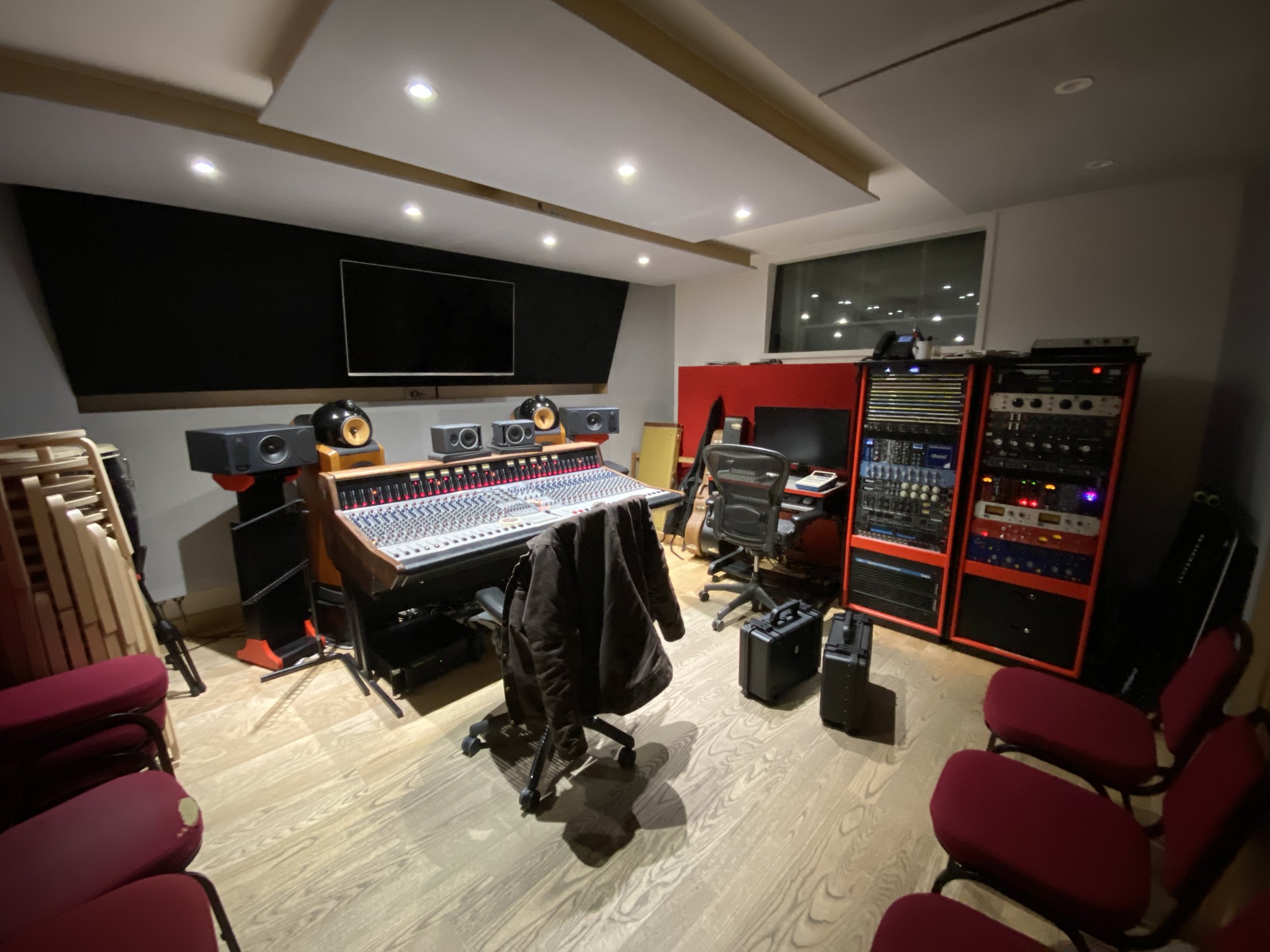
Abbey Road’s Student Studio, The Custom 75, a little dream of a place that I was lucky enough to use as a student…
I’ll leave this with a photo I took of the ‘Custom 75’ student studio while studying at the Abbey Road Institute. It was a wonderful space to have access to, and of course a gorgeous desk and no budget pressures other than availabilities with other students! But you don’t necessarily need this for a ‘professional’ recording, it just helps. I do miss working on a desk though, that feeling never changes - the terror of using what is much like a massive mechanical calculator but for sound… which eventually you conquer and then can’t live without. There’s a perfect limitation - if it doesn’t fit to 24 tracks, then it isn’t worth recording? No?
So to answer my question - I don’t think studios are necessarily something that is going to go away, but their role has been complicated by the accessibility of recording in one’s own home, as well as budgets. Studios are costly to run, and of course costly to hire, but the results are fantastic. It’s a shame that so many major studios have had to close their doors in recent time, you lose history with them, but at the same time these large spaces cannot become museums either - to constantly be looking over their heritage is its own form of death. I do hope that ‘organic’ recording can become popular again, or maybe affordable, in the future. I’m just not sure how we’re gonna get there - maybe without Spotify to start.
Oh and one more thing - Studio 2 sounds amazing, you can’t buy that anywhere else and that’s a hill I’m prepared to die on. Sorry!