Portishead’s Dummy, A (Mostly) Mono Masterpiece
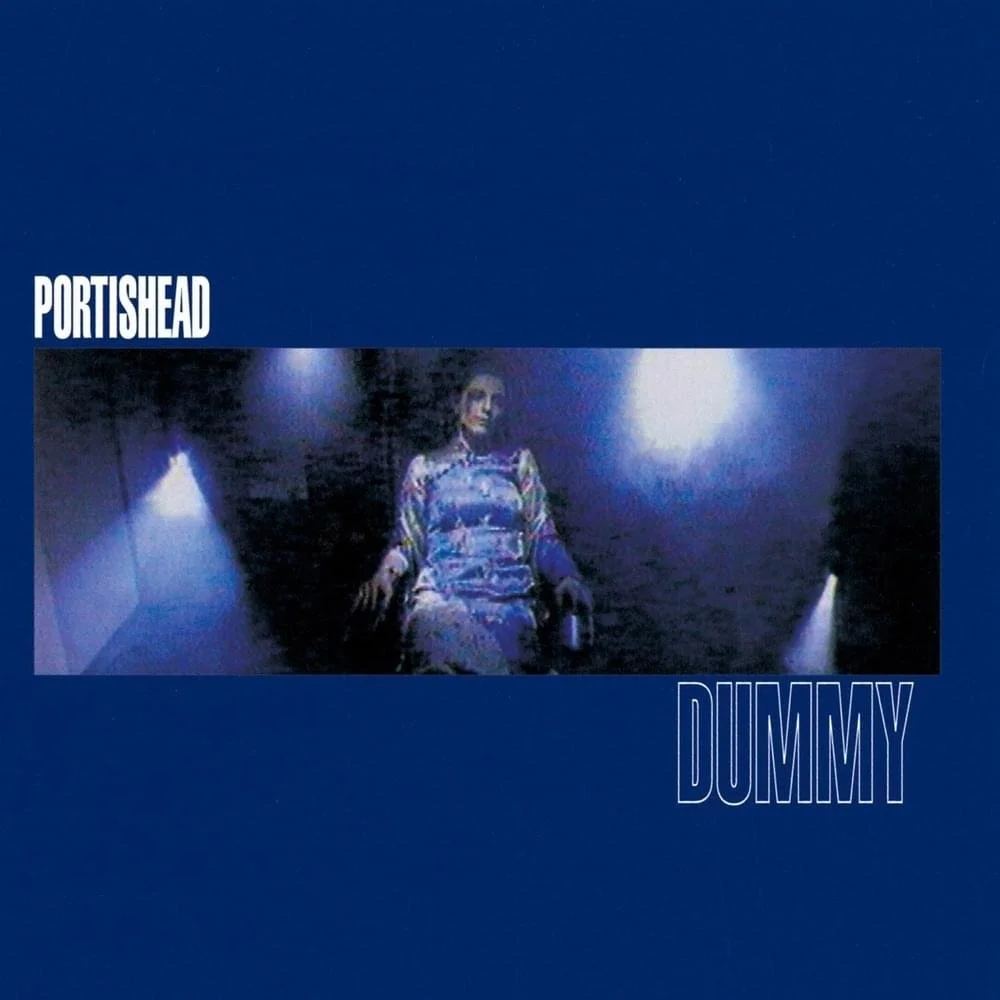
Dummy, 1994
Much like everyone else (I hope), I’m in that stage of post-Christmas-pre-new-years where I’m full of food, not quite sure what day it is, and flip-flopping between being asleep and being well… somewhat awake.
Anyways – this week, given I just remembered today that I should be writing – because I thought it was Saturday… it’s not Saturday, it’s Monday.
So – my listening this week has mainly been Portishead’s Dummy (1994), it’s been a long while since I’ve listened so revisiting it has been a refreshing experience. In fact, I tend to gravitate more towards ‘Third’ (2008) for its slightly more alternative sound. ‘Dummy’ is an album that doesn’t really seem to date, which in a way is funny because its sonic identity largely sits in a vintage sound as is – but I guess that’s part of the effect.
Having done a bit of reading beyond the recording processes, I was intrigued to see that Geoff Barrow (sampling, production, Fender Rhodes) met Beth Gibbons under Thatcher’s Enterprise Allowance scheme, and within a year were recording their first ideas in Neneh Cherry’s kitchen. Before long Adrian Utley overhead Barrow and Gibbons while recording and became involved – forming the core trio that make up Portishead.
Since, ‘Dummy’ has been recognised as a pillar of the Trip Hop genre and its emergence in the 1990s – a melding of hip-hop and electronica, with a sonic identity that revolves around texture and sampling (often movie soundtracks/dialogue!).
Sampling Cubed? - From Tape to Vinyl to an Akai
For an album that is full of processed (and often looped) sound, I was surprised to discover that the album is full analogue – being captured on tape. Maybe that isn’t surprising given the overwhelming sense of Lo-Fi that pervades the album, but to have no interaction with any digital medium (even at mix stage) surprised me.
Take the opening track ‘Mysterons’ (presumably a reference to Captain Scarlet), the track is immediately dark and gritty: the 808 kick drum feels claustrophobic from the abundance of compression applied to it, laid alongside guitar and piano lines that distort – likely from kissing tape more than once. Gibbon’s vocals compound this with oblique lyrical lines to conjure a sense of apathy – maybe ‘did you really want?’ is a question some people may have asked upon first listen. It’s a lot to take in.
The drums are where things get interesting from a production perspective. They were recorded by Clive Deamer, live to tape (16 inch), and were then transferred to vinyl – unusual but maybe not unorthodox – until – they were then kicked, scratched, and abused in every way possible. Doing so dulled sharper elements of the kit, as well as adding all forms of textural crackle and crunch to the sound. These affected vinyl discs were recorded back into an Akai sampler (S1000, gifted by Massive Attack to Barrow) to be cut up and run as breaks/grooves. Consequently, the drums on Dummy have a very unique, saturated sound that would be near impossible to reproduce. It sounds like a lot of work but the result is great, and of course the silver lining is that no samples have to be cleared – much unlike the sufferance of Del La Soul’s 3 Feet High and Rising…
Mono, mono, mono.
Another thing to note – even from this first track, is that the album is mostly in mono. There’s a very small amount of difference between the L/R signals, but the majority of sources are mono as a consequence of the Akai’s storage. I raise this point because there is always endless discussion of multi-channel listening formats – the latest is Dolby Atmos – but my opinion is that mono is in fact as reliable and sturdy as it gets. I love stereo, don’t get me wrong – I have two ears (thanks bilateral symmetry!), so I suppose it’s good to use them – but there are advantages to mono: notably, the huge low end of ‘Mysterons’. Load this track up on a good HiFi system and the perceived weight of the kick is quite hefty. Also… go check Pedestal, that song goes really low.
The same sense of depth can be found in the affecting track, ‘Roads’, a title which I presume is inspired by the signature sound of the Fender Rhodes piano used on it. The first 50 seconds are populated just by the chord sequence alone, a fantastic chance to bathe in the modulating tremolo of the Fender Twin guitar amplifier it was recorded through. From a quick online read, the amp was recorded with the bass cranked to max and the tremolo is out of sync with the track’s tempo… not that any of that matters.
The vocals on this track really define Gibbon’s style, and emotional affect, I’d be lying if I said this song didn’t get the hairs on my arms standing within the first few lines. Again, Gibbon’s oblique lyrics place us in the aftermath of despair, in an act of quiet rebellion:
‘We’ve got a war to fight / Never found our way / Regardless of what they say / How can it feel, this wrong?’
They were recorded on an AKG C414, a microphone which harks back to its C12 ancestor – used on the likes of Sinatra amidst many other famous singers. It’s probably the only hi-fi source on the album, down to the level of hearing Gibbon’s lips part before lines. It adds a layer of intimacy that really enforces the track’s sound. It just really is one of those songs that is immediately recognisable, one that commands the attention of your ears wherever and whenever.
Roland RE-201 Space Echo and Dub Influence
Thus far I’ve mentioned a lot on what makes Dummy unique, but it’s also worth noting some overlap with its contemporaries – united with Massive Attack in particular, for the use of dub textures, all thanks to the Roland RE201 space echo. ‘Pedestal’ features this effect on the vocals, adding a fake doubling where Gibbon’s vocals shadow behind her. It sounds as though its used again on ‘Numb’, adding an extra sense of dimension to the wireless snare (I believe?) throughout, as well as a signature self-oscillating loop around the 3:30 mark. The sound is reminiscent of Lee “Scratch” Perry’s own sound experiments – go read about his – shall we say – ‘baptism’ of tape loops.
I should note I also love Gibbon’s use of different vocal personalities across this album – ‘Numb’ definitely has a (deceptive) nervous edge, mixed with a New York accent. It goes from innocent and sweet to something quite sinister as the lyrics progress. Oh and that simmering vibrato!
Glory Box
I’m not sure why I’m giving this song its own section – it deserves it, but so do most of the tracks on this album. When I mentioned earlier about clearing samples and Dummy being mostly a DIY album, this is the one track (to my knowledge) that uses a very obvious sample – Isaac Haye’s ‘Ike’s Rap 2’. I say obvious, I think ‘Glory Box’ is almost so well known that it seems like the original source these days. The track wasn’t even supposed to be on the album, being perceived as ‘too commercial’ by band members – a song which sold fantastically but that isolated Portishead from the song itself, at least emotionally: ‘you think you’ve communicated with people, but then you realise you haven’t communicated with them at all – you’ve turned the whole thing into a product, so then you’re even more lonely than when you started’.
It’s a fantastic song and I can’t find fault with it – the lyrics are plain but emotive and I think the chorus is one of my favourite vocal performances ever: ‘Give me a reason to love you’, it oozes anguish. Runner up goes to ‘Through this new frame of mind / A thousand flowers could bloom’. I think its easy to forget that the entire track is built around the same descending bassline found in Hayes’ sample, and yet it melts away amidst everything else going on around it. The angry, subdued guitars too – distorted wah – looming like an argument waiting to happen, all before transitioning into a guitar solo that feels worthy of the song it occupies.
The part I always forget is the bridge at 4:10, its short but sweet, briefly punctuated the song with a new ‘room’ so to speak – one built around hard pumping drums, cut up and sampled once again. Oh, and there’s another use of space echo on the vocals!
I should note there’s an incredible cover by John Martyn (and his voice, which would be Guinness if it were a drink) that takes the song more towards a blues direction, again reframing the song with the flipped image: ‘give me a reason to be your man’.
Or, Tricky’s ‘Hell is Round the Corner’ – another Trip-Hop staple. Same Isaac Hayes’ sample but a completely different song, which is also worthy of merit. Again – this is another album I could talk about at length, maybe the closest you can get to Dummyin the Trip-Hop sphere.
DIY Albums
I mentioned earlier having an appreciation for the ‘DIY’ approach to the album, but more on that because I think this really is my overarching point for why this album is so acclaimed. If you look at the songs, most of them are composed quite minimally, often with the same instruments, and then samples layered over the top. However, the actual range of textures, sounds, spaces all feels quite different between tracks – e.g take the clanging whirlwind of percussive bleeps on ‘Strangers’ (which in itself transitions into its own faux-30s break), and the (possibly most) pop-like ‘It’s a Fire’, or the electronica of ‘It Could Be Sweet’. I’m inspired by the idea of an album that is constructed out individual musical performances, that themselves are then disassembled and reconstructed into something new. I think that is in part why Trip Hop is very much its own unique alternative genre, one that is described as capturing the melting pot of culture in 90s Bristol. The genre is technologically defined by its use of sampling (notably the rolled off top end, due to sampling limitations) as well as being a chameleon of musical influences. Dummy I think achieves most, if not all of this. But, on top of this I’d argue the most defining factor of Portishead’s sound is Beth Gibbon’s affected singing style, something which refocuses them into a band more than a ‘group’ so to speak. It should be noted that both Massive Attack and Unkle both relied on guest vocalists for a lot of their albums – not a bad thing per se, but something that makes Portishead feel that bit more special.
With that thought, I wonder if it would be possible to create an authentic Trip-Hop album now, given it is a genre defined in part by technological limitations as well as its own niche geographic social context. I suppose you’d have to start by moving to Bristol, then maybe buying the now widely overpriced and unreliable devices of the time, and then … buying tape? Hm.
A Little Experiment
So I was a little curious about the drum sound, and thought I’d see if I could have a go at creating something similar. I made a short drum loop with the intention of then loading the drums with digital emulations of tape, vinyl, and the filter section of an Akai sampler - oh and Space Echo too.
I think I was a little too light with my processing but here’s the results, I’ve tried to level match where possible:
Plugins Used:
UAD Oxide Tape - On each drum track
Waves J37 - Drum Bus. Not perfect, but used for tape saturation. I lack any plugins that emulate 16 inch tape.
Waves Vinyl - Drum Bus. Emphasis on crackle/input stage.
Imphonik RX950 - A fantastic plug-in that emulates the Lo-Fi effects of the Akai 950 sampler. It turns out the S1000 does not in fact roll off top end.
UAD Galaxy Tape Echo - ‘Drums from Mars’ preset, used as a send.
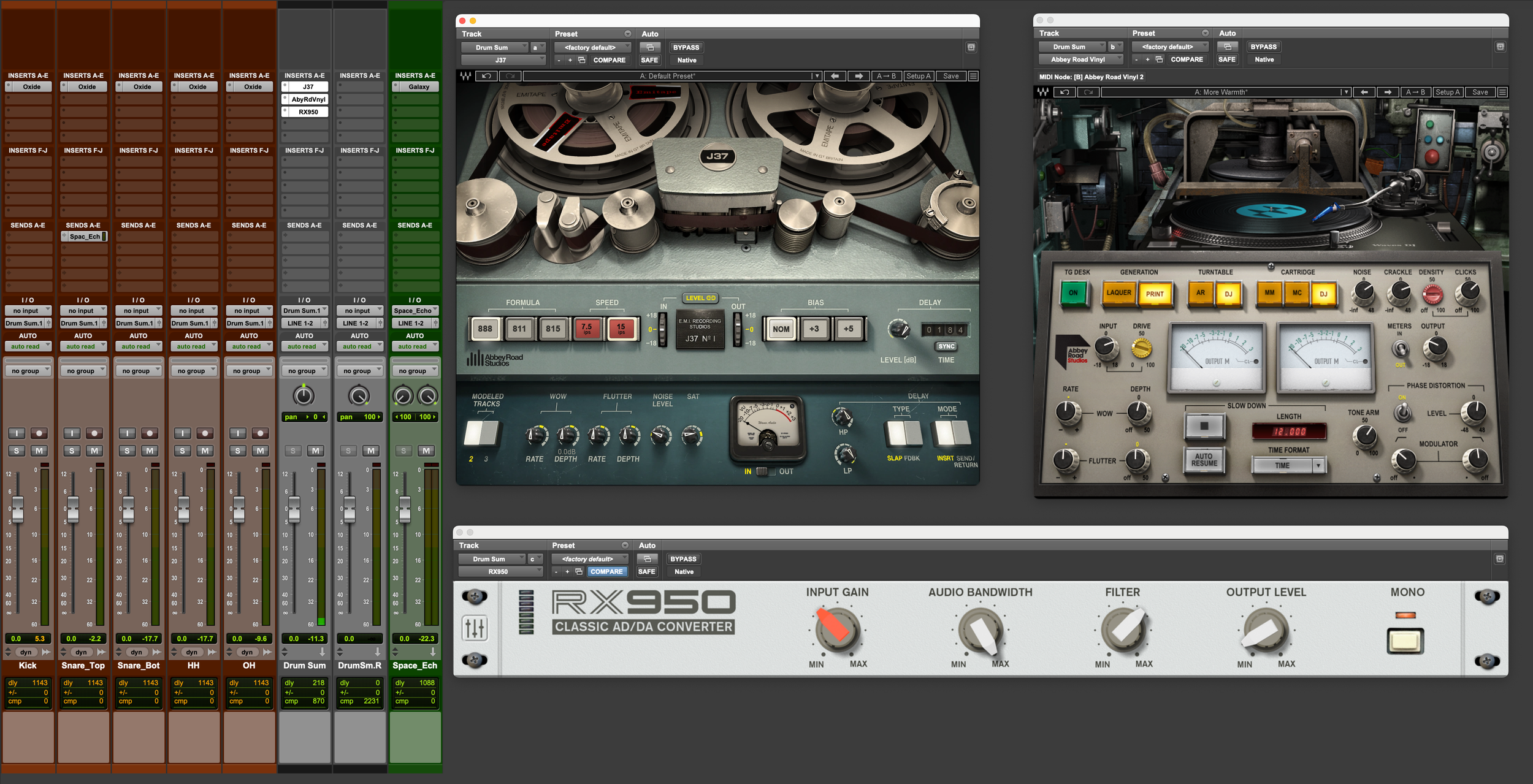
The Pro Tools session and plug-in settings.
I think in conclusion, the effect is cool but maybe very reliant on the context of a track and so is hard to mix in without surrounding elements!
Recommended listening beyond Dummy:
‘Third’ – Portishead, 2008
‘Maxinquaye’ – Tricky, 1995
‘Psyence Fiction’ – Unkle, 1998
‘Mezzanine’ – Massive Attack, 1998
‘Protection’ – Massive Attack, 1994
‘Splinter’ – Sneaker Pimps, 1999
Audio Jargon Clarification, for the people that actually go outside on a daily basis:
Hardware Saturation – this is a form of controlled distortion that is imparted when an audio signal’s input cannot be reproduced at output in a linear fashion. In small amounts, the effect is a ‘smoothing’ of a sound, that is caused by a very soft compression as well as generation of additional harmonic content. The result of saturation (and perhaps what is important amidst this further jargon, yikes) is that a signal sounds fuller/thicker – but too much and the signal begins to sound brittle and gritty, which in this case contributes to Dummy’s sound. Saturation is a bit more nuanced than this, but this works for now!
Tremolo – an effect achieved by a mono signal varying in volume across a rate (either set or also varying, e.g against a waveform), or in stereo – a variance of volume between the left and right sources.