The Episodic Song Structure
Have you ever heard a song with an episodic song structure? Probably - the most obvious answer (or common answer) is Queen’s Bohemian Rhapsody - a song that feels like a theatrical journey, with acts. It’s so good Lee Evans managed to make a ten minute comedy sketch from it - which is also well worth a watch, if you can find it online…
Although Queen’s song is intended as parody, the term ‘rhapsody’ (derived from the Greek - rhapsoidos, meaning a reciter of epic poetry) began use in Europe in the 16th century, first for literary forms and later for any spontaneous/wide-ranging expression of emotion/sentiment. Eventually the word’s meaning came into association with music and nowadays it tends to refer to a single movement work but that features episodic/seamlessly flowing structures of contrasting moods/colour/tonality.
It’s probably safe to say that it’s not the type of form that fits into ‘popular’ music and for that reason it often stands out as a unique and memorable structure when it does emerge. I think in part, because it’s probably difficult to write a bad rhapsody… given it’s a strange form to begin with - or so we may think, coming from the world of three minute ditties.
I should add - I am not including prog rock in this because I reckon you could write at length about the areas of comparison and difference between prog rock and rhapsody. Compounding that - I have no authority on prog rock as it’s never (or not yet) managed to pique my listening interest. Given its lack of re-emergence in music, I suspect that might be the case for a lot of people. No doubt it’ll come back eventually, everything does.
So I thought about a few examples I might consider for this ‘episodic’ structure, with an emphasis on the power of contrast between sections - these are as follows:
‘A Day in the Life’ - The Beatles - 1967
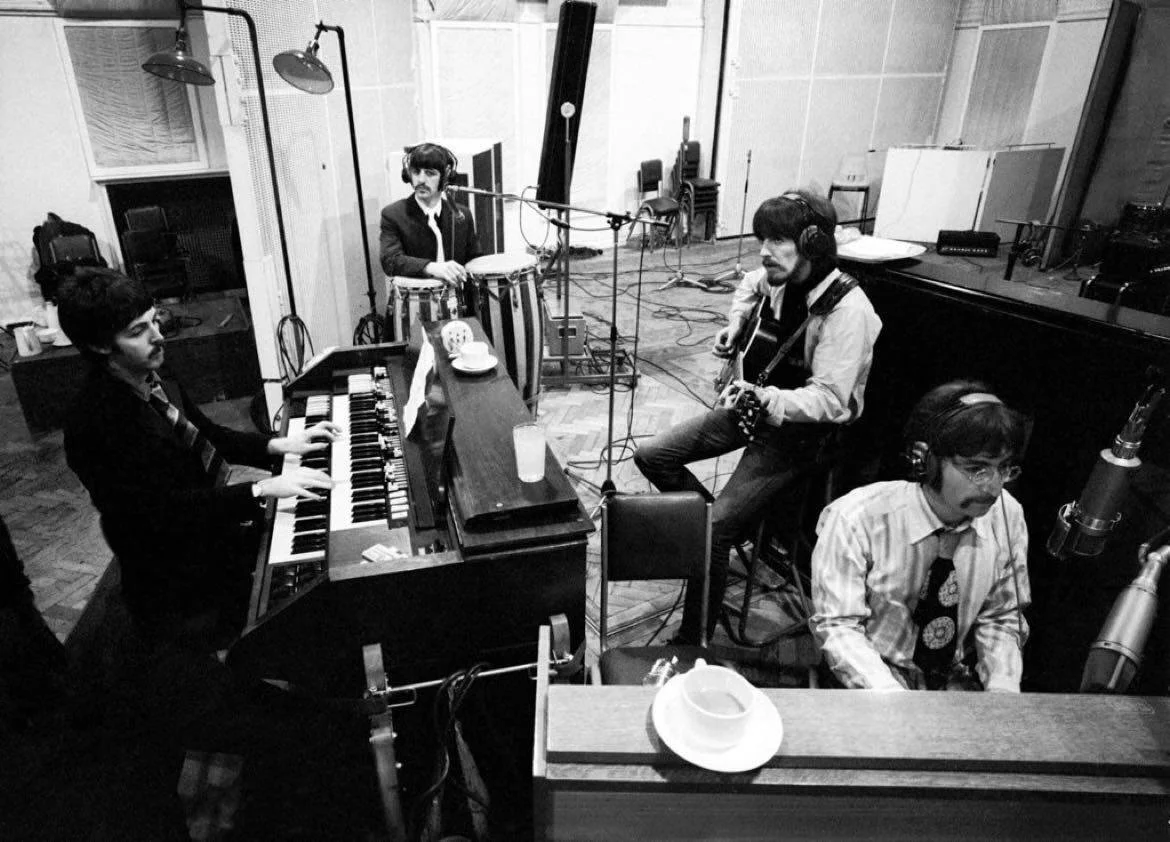
The Beatles recording ‘A Day in the Life’ - notably, George was absent during the recording of the pianos for the outro with Mal Evans stepping in.
This monumental track is now deemed (or so I’ve read) to be the greatest Beatles track - I’ll leave that to others to dispute, I don’t agree but how can you assess the ‘greatest’ achievement of a band that revolutionised most of modern music in the space of about seven years.
The song is a bit of a sandwich, where Lennon occupies the beginning and end with McCartney filling out (ho ho) the middle. The two wrote the entirety of the song together however, but without the sections explicitly figured out until recording began. Importantly, this song took between 30-40 hours to record, whereas a few years prior they had recorded an album in 10. Of course - with the limitations of technology, recording during the early 1960s was largely dependent on capturing a band’s performance there and then, with little modifications made afterwards. By the time of January 1967, technological advancements had come on and I think ‘A Day in the Life’ begins to foreshadow the ways in which writing and recording could blur into one process for artists.
The sharpest contrast in tone exists between the first third, and middle section of the song. That is, between Lennon’s melancholic verses that draw from the news and McCartney’s alert, upright narrative of a daily routine. Between the two, there is a shift between the absurd topography of a newspaper blending the entirety of the world’s events on one stage and the personal mundanity of a workday morning. Between these two, there emerges an absurd account of ‘A Day in the Life’ - that is, the somewhat psychedelic mish mash of lived accounts blurring into one single continuous experience.
This is reflected in the song’s structure: three verses, a refrain, interlude, bridge, verse (return to Lennon), refrain, interlude, and finally an outro. More on that in a bit!
Upon first listen - the initial verses and tone of the song imply it will be a slow melancholic ballad, reflecting on life:
‘I read the news today, oh boy
About a lucky man who made the grade
And though the news was rather sad
Well, I just had to laugh
I saw the photograph’
There is a detachment between Lennon’s subject matter and his reaction to it - at once the news is heavy but turns comedic in an unnatural reaction, or more likely - an anxiety response. Accounts suggest the biographical connection here is with the death of Tara Browne, heir to the Guinness franchise and friend of the band, however McCartney instead associates the subject with a politician’s suicide. Already there is a distortion between subjects, blurring the lines in the song’s sense of ‘concrete’ narrative.
With this in mind then, the suggestion of laughter in response to a photographic death seems to reflect a wider acknowledgement of life’s absurdity and the tendency to apply gallows humour to bad news. The lyrics of the Beatles at this time were mostly nonsensical (in their raw form) anyways, but it is the interaction of these lines in the song format that begin to promote a wider meaning - the strange feelings of dissociation in everyday life.
‘He blew his mind out in a car
He didn’t notice that the lights had changed
A crowd of people stood and stared
They’d seen his face before
Nobody was really sure if he was from the House of Lords’
Lennon’s account is further blurred between the historical account of Tara Browne’s car crash and this interpretation of a politician’s death. Either way, Lennon’s point is that such details are inconsequential as the scene zooms out, first to the dark comedy of traffic lights, and then the confusion of a public audience. In this instance, death becomes horrific from its presentation as spectacle rather than existential concern.
‘I saw a film today, oh boy
The English Army had just won the war
A crowd of people turned away
But I just had to look
Having read the book’
Mirroring the first verse, the third zooms out further, returning to personal account and reporting the crowd’s disinterest in a wartime victory. If war is old news, then the focus is instead on the transient spectacle of the car - more simply, a movement from generational achievement to the unfortunate downfall of a middle class figure. From this, the song takes a psychedelic turn - ‘I’d love to turn you on’ (referring, firstly - to LSD) - introducing a greater ambience with the pulsing piano and orchestral section begins its crescendo. The result is an impression of psychedelic horror - an overload from the voyeuristic experience unfolding in front of us. At no point do these verses seem to imply who it is experiencing a day in the life - is it Lennon’s voice, the crowd, an onlooker?
From this transition - a sudden switch to a major tonality, and an alarm clock (primed in the studio by Mal Evans). If you listen closely you can hear McCartney uttering ‘one’ to note where his vocal should enter - useful if you notice that the twenty four bar section is in fact about twenty three bars - the orchestral doesn’t quite remain in time, I imagine this is due to trouble synchronising the tape overdubs.
McCartney’s ‘day in the life’ is pleasantly naive: waking up, fixing his hair, and having breakfast before rushing to work on the bus. In this account, life is upbeat, jolly and regimented by a regular pulse. Of course then, it’s marijuana that seems to psychically connect Paul back to John - ushering in the next moment of transition, with laidback drums and a climbing baseline, just as John’s ‘aah’ pans left to right in the stereo field… as dreamy as it gets for 1967. Maybe.
The fourth verse is fleeting - addressing the minutiae of potholes in Lancashire, associated then with the Albert Hall. Beyond a transition into the absurd (if we weren’t there already), the lyrics become less important than the music - notably the outro which makes this song famous.
In order to achieve Lennon’s dream of a ‘musical orgasm’, McCartney wrote 24 bars for the orchestra, with instructions for each player to independently work their way up from their lowest note through to the highest, without any attention being paid to their neighbours. Finally then, the ‘wall of sound’ achieved through twelve (3 pianos tracked four times over) playing a sustained E Major chord. To avoid tape hiss, the pianos were recorded with heavy compression (to reduce the attack and prolong sustain) before Geoff Emerick slowly pushed the console faders up to fight the dying reverberations of sound - all while Paul and gang stood silently in Studio 2 for around a minute at a time.
I think the importance of ‘A Day in the Life’ stems from the equal collaboration of Lennon and McCartney to compose a song that shifts between so many musical moods and lyrical reflections, creating a wider meaning of the song’s title through nonsensical parts - a sort of Kafka-esque reflection on everyday life. Further to that, and more to the title of this post - it’s musically very experimental for its time and even now. It’s unique for various reasons, the iconic opening melody, the melancholic piano lines, the sudden tonal shift in McCartney’s bridge, the final pianos… it offers popular music as being capable of embracing the experimentalism and making it accessible. In doing so, it reflects the absurdity of life at the time - socially, but still remains relevant today because of the thematic ‘dissociation’ that comes about as a response to an absurd world.
‘Bohemian Rhapsody’ - Queen - 1975
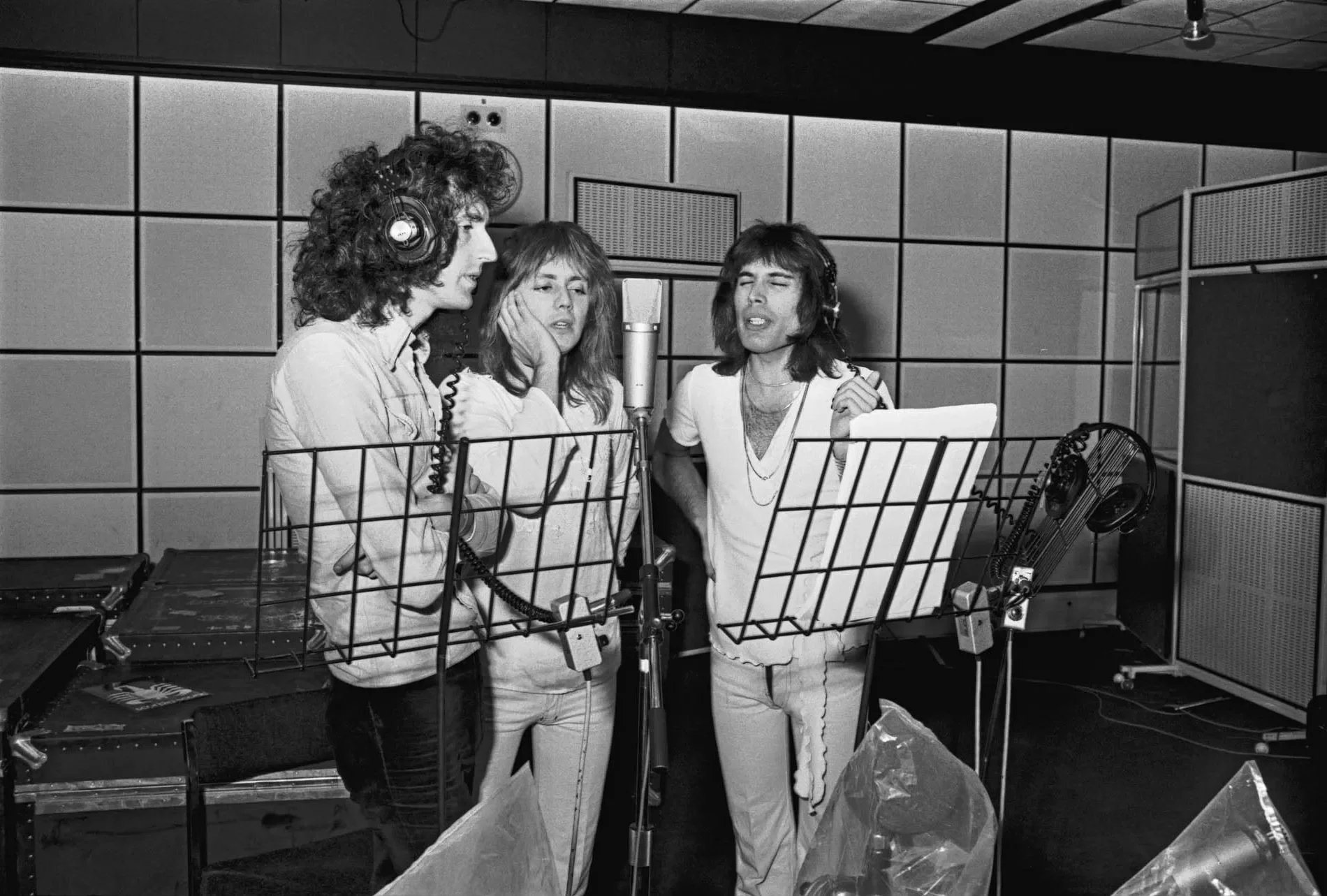
Vocal overdubs for Bohemian Rhapsody - or so I believe.
So if you were going to think of a song that is made up of parts, with various contrasts in tone and emotion, it’d be this one right? Much like ‘A Day in the Life’, there’s not quite a song like this. Instead of opting for a chorus as a structural ‘home’ for the song, it instead moves from the multi-layered vocal intro, to narrative piano ballad, an opera (?), a rock breakdown, and then finally a reflective outro. If it’s a progressive rock song, then it’s one of the few that is immediately accessible - dare I say even popular with the mainstream.
The recording of the song (at least the main elements, not the many vocal overdubs) was achieved in a single take. The first section, a little like ‘A Day in the Life’ seems to start in media res - having some form of epiphany in a dream like state. Emphasised by the vocal harmonies, creating a slightly uneasy (yet beautiful) set of chords across the stereo field. For those less geeky about the technology of recording, the natural phasing of Mercury’s vocals are in fact a result of his pitch being so accurate across takes - leading to the very slightly discrepancies in pitch/vibrato causing the vocal harmonies to thicken and move in and out with one another.
Famously, we learn that the song’s ‘hero’ has killed a man, appealing to their mother as a witness over the sudden guilt and consequence of their split-second decision. But of course, ‘nothing really matters’ - a little like ‘A Day in the Life’, but now with more of a theatrical effect - even with some comedy dare I say. If we’re using the rhapsody to mean this sense of poetic epic, I guess this really captures the point of the ‘hero’ addressing the challenge ahead. In a clever way, it plays upon a listener’s expectation of the piano ballad trope to reinforce this space of musical reflection. Notice how the drums and guitar emerge with select lines - ‘throw away’ and ‘face the truth’. This is the rising section where you’ll find a middle aged man, in a pub, gesturing the words - pint in hand. I don’t know why. They say music is powerful no?
Following the guitar solo, the operatic section is perhaps the most famous (iconic even?) part of the song. I think perhaps this is the key to the song’s success in the mainstream, the sense of theatre is palpable. Even if the majority of famous singles have been from typical A to B structures, Bohemian Rhapsody bucks this trend for being so unusually magnificent. Again - like ‘A Day in the Life’, this sudden shift is marked by a major tonality and Mercury’s more dramatic, over pronounced vocal delivery. I should note, this is the most complex part of the song too - both musically and technically. There is a modulation between keys in rapid succession as the band sings over chords in a choir format… reportedly achieved from recording over 180 overdubs onto the desk. In doing so, the actual tape used slowly became transparent from its oxide being magnetised so many times over.
This change in scenery, into a sort of - well - theatrical courtroom with a Greek-style chorus, enables the absurdity of this moment to transcend being cheesy and instead elevate the song’s drama. Now our central character finds himself pleading for his fate as the history of his life and actions are thrown back and forth to find justice.
So resolution comes without an orchestra, but with an epic rock guitar solo. If the opera section is the most complex and theatrical, this section is the necessary contrast to release the song’s tension. There are even little hints of prog rock in some of the guitar lines, climbing over themselves to their freedom. Finally, ‘nothing really matters’ seems less absurd and more … liberating. For such success, it’s far from a love song but instead concerned with murder and nihilism! Is there a pattern developing here? I sense some overlap with Albert Camus’ ‘L’Etranger’ as well as allusions to Dr Faustus in this song.
‘Paranoid Android’ - Radiohead - 1997
Studio 2’s control room, Radiohead recording ‘Man of War’ (via ‘Meeting People is Easy’ documentary). There are little to no photos of the recording of OK Computer.
My final consideration is also my favourite of the three - predictably. Where ‘A Day in the Life’ captures the drug induced miasma of everyday tragedy and the absurd, and Bohemian Rhapsody invites us to a world of operatic theatre, Paranoid Android takes us on a journey of pre-millennial neuroses - a song which seem to resist any central subject matter whilst evoking a series of images. The song itself was inspired by Bohemian Rhapsody, being constructed from several songs (or three different moods) that Thom Yorke had on the go at once. In fact the original was around 14 minutes long and featured an extended hammond organ solo - it’s cool on first listen but I’m glad it was cut.
It was the first time I remember listening to music and thinking ‘this means something’ - not just because of the song, but as a teenager appreciating the importance of music as a higher art form and no longer listening for the sake of a pop hook/catchy riff. I watched the video on YouTube and was quite confused yet entertained by what I watched - notably the single day epic of a cartoon character living his life, experiencing violence in a bar, and watching a man in a suit cut himself up into pieces before being reimagined as a baby… so I suppose there you go - the song’s themes: a world built on anxiety and noise, -politics, capitalism, slogans, yuppies… cheery stuff.
Chosen as a comedic title, the reference to Marvin the Paranoid Android (of Hitchhiker’s Guide to the Galaxy) reflects the sense of alienation experienced by the song’s central voice - ironically.
‘Please could you stop the noise? i’m trying to get some rest
From all the unborn chicken, voices in my head’
These bizarre lyrics come about after the introduction, comprised of cabs played over a drum groove and a fingerpicked acoustic progression over G minor, coupled of course with a few atmospheric guitar flurries (phaser/pitch shift). I’ve always interpreted the lyrics as absurd but I’m starting to wonder if the reference to unborn chicken voice suggests a pre-emptive cacophony of clucking exclusive to the anxious mind.
Quickly the song is elevated into a brief refrain, marked by Ed O’Brien’s pitch-shifted guitar arpeggio - mirroring the acoustic and introducing an atmospheric timbre that intensifies this sense of anxiety. As Yorke begins a sustaining call of ‘what’s that?’, Marvin the Android plays in the background - it’s surreal and compelling, and of course is a self-deprecating comment on the melodrama of Marvin as a depressive figure. Compounded further by the ‘first against the wall line’ - a fictitious daydream of power and justice for the paranoid mind. More telling however, is ‘your opinion which is of no consequence at all’. Throughout the song there is a sense of life, opinions, values, being throwaway and disposable - more commodity than anything concrete.
From this, the song transitions into its second section - a sudden shift to a drier, more focused acoustic riff and a quick switch to 7/8 time with the introduction of Colin Greenwood’s bassline, and Rhodes Piano.
‘Ambition makes you look pretty ugly
Kicking, squealing, Gucci little piggy’
Perhaps the more iconic lines of the song - these refer to an unpleasant experience Yorke had in an American bar, surrounded by cocaine fuelled groupies. Such paranoia shifts outwards to select individuals - I often think pigs are cute and get a bad rep through the form of artistic metaphor and simile… but I suppose here the sense of a spoilt personality works. Between the animalistic and the status of designer wear, there is a targeted attack upon the artifice of greed and ambition consuming an individual’s character - where the song’s paranoia was at first inward, it’s now outward. Just like the cynicism of ‘A Day in the Life’, the song’s voice dissociates from society, seeing it for all its strange behaviours and habits - like an alien might.
Back to 7/8, and at once the song seems to occupy a strange sense of floating hysteria between sections.
And Wham! In comes the middle section, now with the acoustic riff passed on to the command of distorted guitars. It’s a brief spike of anger from the mindset of the paranoid king mentioned before:
‘You don’t remember
You don’t remember
Why don’t you remember my name?
Off with his head, man
Off with his head, man
Why don’t you remember my name?
I guess he does’
In this brief moment, it seems to be the downtrodden individual - like Marvin - actually giving into inhibition, fighting back to be acknowledged as an individual. I suppose this really satisfies the rhapsodic moment of ‘contrasting sentiment’. Naturally then, as with any emotional outburst, there is a moment of wallowing to follow:
The song now adopts a quieter, slower paced attitude - marked by a set of descending vocal lines in the 9, 11, and 3 o’clock positions (panning wise). We’re transported back to the melodramatic isolation found in the first section - with the refraining ‘rain down, from a great height’ (originally hallelujah) the song moves into a cathartic release of despair. I love the vocal counterpoint that follows the first run of the section:
‘That’s it sir, you’re leaving
The crackle, of pigskin
The dust and, the screaming
The yuppies networking
The panic, the vomit
The panic, the vomit
God loves his children
God loves his children, yeah’
I couldn’t ask for more - to me, an image of a drunken man leaving amidst an absurd series of despairing images. There’s indifferent suffering, the biblically apocalyptic dust and screaming, and then the contemporary contrast of status obsessed yuppies in the 90s. From here - ‘ad nauseum’, literally, and the sarcastic final reproach of ‘God’s children’. It’s dramatic, and self-aware of course - and indeed very fatalistic, but I think that is what elevates the song into a wonderful depiction of social chaos. Is it an android failing to gain humanity, because of its sickening presentation, or is it a human losing their own sense of humanity through the perception of others? We have both the theatrical trial of Bohemian Rhapsody, pushed throughout in the high and low brow themes of capitalism and Biblical proportions, and then the cynical dissociation of the voice in ‘A Day in the Life’. And what song doesn’t end well unless it has some manic ‘LA LA LAs’ to underpin it? Right?
A Scarce Form
While writing, I considered my honourable mentions of Led Zeppelin’s ‘Stairway to Heaven’ and of course the other prominent contender: ‘Happiness is a Warm Gun’ - especially for its frequent change of lyrical themes, tone, and musical rhythms/signatures. So maybe listen to those too, if you’re in any way interested…
So what about the episodic song? Well - it seems to be a very rare format, and I wonder if that’s because it’s either hard to do well or at least not something that tends to emerge from artists thinking about a series of subjects/images. Across these three songs it’s very evident that all three are comprised of voices that go on transformative journeys or experience, either directly or from observation of the world. They are, in their own little way, a sort of musical bildungsroman - apart from the fact, there is often little enlightenment to be found. Instead, their positions are reinforced or remain unchanged. Either way, I think all three of these songs, especially my Radiohead and Beatles example demonstrate a perpetual desire to reflect the absurdity and cynicism that can be found from the world when paranoid connections are drawn - is it rational? I’m not sure, but there is a great deal of affect to be taken from it. I think both ‘A Day in the Life’ and ‘Paranoid Android’ reflect their relevant social zeitgeists, detailing the anxiety associated with individual thought and an anxiety towards herd mentalities.