Review: The Mountain - Gorillaz
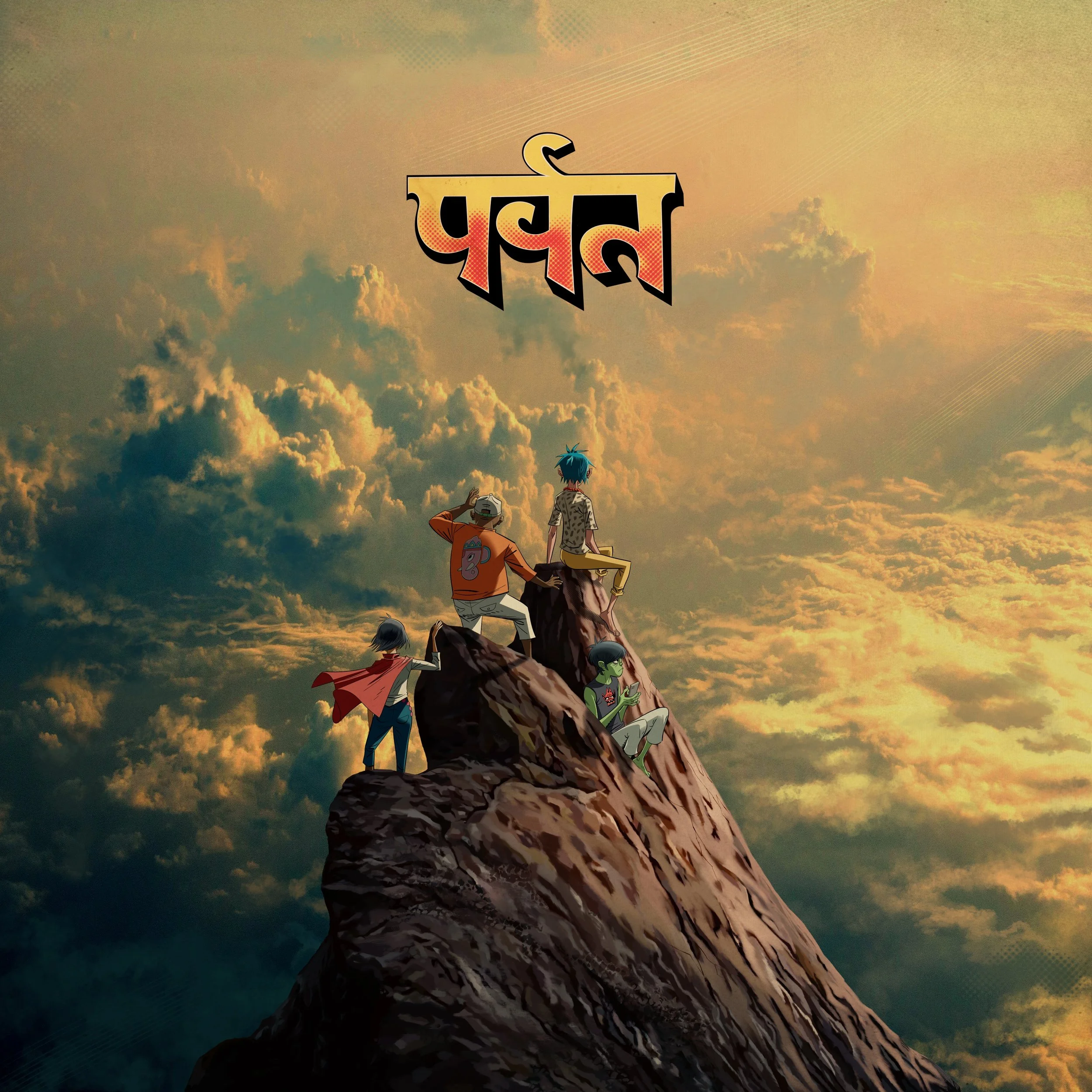
The Mountain (2026)
Falling out (and back into) love with Gorillaz…
Gorillaz have long been a soundtrack to my life, with the early albums like Demon Days (2005) and Plastic Beach (2010) making up a good deal of my musical listening as a child. It seems I’m not alone, as it seems for many fans those two albums marked the core period of Gorillaz’ appeal and identity - both visual, and musically. Following frontman (sort of) Damon Albarn and artist Jamie Hewlett’s short-lived feud and a brief resurgence of Blur, the band returned with Humanz (2017) to envisage a ‘dark fantasy’ world where Donald Trump won the U.S Presidential Election - ho ho. Here we are again. Politics aside, Humanz ushered in a new energy for the band, away from the grittier trip-hop/dub, rock, and synth-pop elements of the first three albums and into territory of RnB and dance. The result, an album with a wider array of contemporary artists and a new band line-up. I remember on release I may have listened once or twice but for whatever reason couldn’t find my way in. In retrospect, I think I was afraid of the new, and instead longing for an album with more of a focus on Albarn’s presence in the songs, accompanied by select big names. There was definitely a sense of each song on Plastic Beach (or Demon Days) contributing a sense of plot or event to the worlds of their album. One should note too, the wide array of music videos and visual content made for those albums - notably because of bigger budgets and a wider interest in music videos at the time. Nowadays, I love Humanz, I think it’s my third favourite Gorillaz album but I hold it as highly as the two I mentioned previously. Before writing here, I also saw several music magazines deeming The Now Now the worst Gorillaz album - which I firmly disagree with, though perhaps it is to Humanz as The Fall (2010) is to The Plastic Beach. Damon, on his iPad, writing songs.
Since then, the Covid-19 pandemic came about and so did Song Machine, Season One (2020) - tentatively made episodic in case of the pandemic lasting longer than it did. How long was it now? One year condensed into what felt like one day, weird. Again, this reshuffled the Gorillaz’ identity, presenting a trickle of select songs with other locked-in artists, accompanied by videos. Largely, I think the album lacks a sense of flow but is a great compilation of strong songs that stand on their own, even if they don’t relate at all. That and my least favourite track by the band… ‘The Pink Phantom’. Anyways.
Then came Cracker Island, an album I’ve only listened to once. I tried to like it, especially with the amazing singles: ‘Cracker Island’ and ‘New Gold’, but the rest of the album disappointed me. All the strange musical obscurities, synths, sampled drums, of previous albums seemed to be absent here, it even felt like Albarn had taken a backseat - delivering the occasional few lines or making his presence known in backing vocals. Put concisely, it didn’t feel like a Gorillaz album so much as any other adjacent pop-record, compressed to hell and back.
So when I heard about The Mountain (2026) I turned a blind eye (or ear) frankly, I wasn’t in any way bothered or excited for the album’s release and had put the band in the back of my mind. However, since release, and listening, I think I can quite happily say that this might be the best Gorillaz release in quite a while - it still isn’t in the same arena as my prized three, but it’s up there. So without further ado - my sweeping review, track by track.
The Mountain - An Afterlife from the Cutting Room Floor
The album deals with themes of death, grief, and the afterlife, having been recorded and written during visits to India by Albarn and Hewlett - both of whom had lost their fathers. Subsequently, the album is comprised of many posthumous guest features - such as actor Dennis Hopper, soul singer Bobby Womack, punk vocalist mark E. Smith, rapper Proof, De La Soul’s David Jolicoeur, and drummer/longtime collaborator with Albarn, Tony Allen. In Albarn’s words: ‘I just thought, if we’re going to talk about the subject of death, I need some people who are dead to help me talk about it.’ Reading further, Albarn had also intended to use vocals from Lou Reed but was denied permission by Reed’s estate. Terry Hall was also intended to feature but any unused vocal takes had been discarded by the recording engineer of previous sessions.
Given Gorillaz' recent 25th anniversary (longer than Blur’s tenure now!), it seems fitting then that this album would call back o many of the monumental figures that comprised the sound of Gorillaz’ first few records. I must admit I’m sad that Terry Hall was unable to feature. From a production perspective, I was a little apprehensive as to how these ‘offcuts’ or disused takes would find themselves on the album, but I think by and large any features are done with an elegant touch to accompany other guest features. I’ll get back to this in a bit.
The introduction of Indian instrumentation is also a welcome addition - especially given Albarn’s own musical pursuits in world music across his solo career and other musical projects. It’s nice to hear that infiltrating Gorillaz’ sound to widen the already vast array of tonal palettes that exist across the band’s albums. I would say I feel it’s more of a musical backdrop across the album, than a focus, but it fits nicely as a musical cocoon so I won’t complain.
Before I get into analysis of songs and wider discussion of the album - I should say that my surprise, and enjoyment of this albums stems from its cohesion. I don’t think a Gorillaz album has had as good a flow since Humanz, and it seems to have bucked the annoying trend in recent times where an ‘album’ no longer denotes a complete listening experience from start to finish. I think that is one of its great strengths.
Side One - Caves and Musical Reflections
On first listen, I spent all of side one with a big grin on my face. The opening track is vaguely reminiscent of the orchestral intro of Plastic Beach, building musically before flourishing into a sunny array of droning sitars overlaid by soaring Indian flute (Bansuri) and the backdrop of Indian percussion (Tabla and Dholak). Eventually the song seems to sail into a cave, one inhabited by a cacophonous echo of Dennis Hopper, and not in a bad way.
This leads nicely into the album’s second track - ‘The Moon Cave’, opening with strings in the style of 70s disco, and then morphing into a backdrop of Indian choir and orchestral elements. Then, the welcome return of Bobby Womack - for me, the second signature voice of Gorillaz beyond Albarn’s own vocals. From the moment I heard Roland drum machines, synth bass, and of course Albarn’s police radio vocals - I thought: ‘yeah this is it! We’re back! Nice!’. Doubly enjoyable given I had gone in with doubt and been pleasantly surprised. This song offers so much in the way of tonal variety and transition, blending Indian instrumentation with synth-pop, and then an entirely new ‘part 2’ halfway through. That is - a rhythmic change into a pulsing kick pattern and ‘sucked’ (that is, reversed) hats while Black Thought raps a rhythmic counterpoint to Dave Jolicoeur’s musical soundbites. Hearing such a plethora of voices, both part of Gorillaz legend and new arrivals, in one song left me thinking that Albarn had inadvertently cracked my longing for an echo of Gorillaz past tonal palette. This song specifically feels like its own glimpse back to the sound of Plastic Beach whilst ushering in the album’s central topics - and notably, the song is a delightfully optimistic consideration of loss and mourning. Finally, it feels as though Albarn’s vocals have regained a sense of pathos similar to that of ‘El Mañana’.
From this sailboat journey, and the moon cave, the faint whirring of a Prophet-6 synth concludes the album’s first side with ‘The Happy Dictator’, a song inspired by the dictator of Turkmenistan, Saparmurat Niyazov, who inadvertently banned bad news by asking his people to remove their bad thoughts. The song features Sparks, and to my ear is an absurd five minutes of electro-pop with an overwhelming sense of the major key. Of course, this is accompanied by Albarn’s vocals which function as a lyrical self-help book, undermined by Spark’s choral ‘Oh what a happy land we live in’. It feels all too aware of the gloom of the present day news. It’s more of a single than a deep-cut, and it doesn’t rank so highly for me across the album - but it’s not bad either. I’d never have Sparks on the cards for Gorillaz, but it works well, and I suppose could have been musically forewarned by Jean Michel Jarre’s appearance on Humanz.
Side Two - Legacy, Oblivion, Empty Dreams
‘The Hardest Thing’ reveals a weightier, tender side to Albarn’s vocals - reminding me slightly of the tone adopted on Blur’s The Ballad of Darren (2023). Opened by Tony Allen, it seems to function as a musical requiem for the album - locating itself in present grief and then envisaging a party in the afterlife.
Albarn’s opening lines then spill over into the next track ‘Orange Country’, again picking up the album’s pace. For me, this is my favourite track - Albarn’s vocals meld beautifully with Kara Jackson’s guest vocals, extending this sense of thematic grief into anxieties about legacy (as tribute to one’s parents) and the recollection of ‘everything you gave to someone you love’. Again, I wasn't expecting the emotional depth of the song and was pleasantly surprised. To me, it seems to capture the delicate melancholy that made the first few Gorillaz albums stick with me - that sense of the upbeat but with the looming shadow of melancholy (often through Albarn’s vocals). For this song specifically, it lightly addresses the fear we all have about losing parents - the silent witnesses that validate and form our entire identities, and then the inevitable moment that we are orphaned and suddenly left to fend for ourselves.
Prior warning - the song’s whistling ear worm will stay with you for a while…
The presence of Joe Talbot on ‘The God of Lying’ came unexpectedly. To me, this song feels a little disconnected from the rest of the album - especially the Indian influence. It’s another of my favourites, but to my ear seems to belong more on an album like ‘Song Machine’. From ‘Orange Country’, the scope changes quickly from personal loss to ‘good grief’ - more specifically an exploration of desensitisation in response to a world of bad news. Of course, Idles frontman, Joe Talbot is a fantastic choice given his ability to deliver question after question with a sense of both aggression and softness:
‘Are you dying for an answer for what they call good grief?
But there’s a terrific chance there’s nothing, beyond what you believe’
I think these lines are the linking point to the album’s themes and that surmise the song. It’s a rumination on apathy and false hopes. Unlike the thinly veiled facade of ‘The Happy Dictator’, the ‘God of Lying’ is direct in its consideration of individual oblivion through alcohol and drug abuse. Unlike the spiritual afterlives found so far on the album, this track is the first to be existentially troubled by a consideration that there is no great beyond. Tablot’s tone is dismal, but consoling, acknowledging the tendency for individuals to seek individual oblivion through means of substance abuse to alleviate their impossible troubles, and more widely the numbing effect of persistent bad news. There’s a flavour of dub to the song’s slow, plodding rhythm alongside the use of carnivalesque melodic phrases across synths and samples. I’m particularly fond of the twisting, pitch-modulated vocals by Talbot during the bridge.
This darker tonality transitions over into ‘The Empty Dream Machine’, a slow electric synth-based groove with Albarn’s exposition of the ‘empty dream machine’, the idea that we are all limited by a lack of faith in our dreams and so choose to keep them as lofty thoughts instead - never realising the work required to make them real. More widely, it seems through crawling - or rather hard work, Albarn finds his own way out of being imprisoned by his own dreams. I suppose, it’s a doubled edged sword for both being transfixed by grief and the unpredictability of the creative process. I think the strongest part of this song is the Black Thought’s rap verse - which, dare I say it, is maybe one of the best in the Gorillaz’s discography - it certainly reminded me of MF Doom a little. It puts intro practice Albarn’s contemplation on dreams, painting a series of images of personal struggle with comparisons to elements of Indian culture and religion, Alice in Wonderland, and racial identity. Supposedly Johnny Marr is on this song, but I’m not sure where - he seems to have disappeared into the mix, perhaps shadowed by Albarn’s overly autotuned vocals…
Side 3 - Flimsy Steve, Some Weaker Tracks
I think the second half is where The Mountain begins to lack some weight. That’s not to say the tracks aren’t enjoyable, but they seem to have less stopping power.
‘The Manifesto’ features perhaps Albarn’s most deep, insightful lyric yet - which is sarcasm of course:
‘The mountain it is high, yeah
The mountain is sad, so the mountain cry’
I admit I laughed a bit when I first heard this lyric, and I’d best attribute the excellent British term ‘naff’ to describe it. By all means it serves the song and works but it does feel like a literal embodiment of the ‘flimsy Steve’ meme which came about a few years ago - you can find that here. Never thought I’d attach a ‘know your meme’ link to a blog post but here we are.
I do think ‘The Manifesto’ is a good track, again - like with The Moon Cave, it is elevated by its second half with the emergence of Proof. I admit, I was unaware of his rapping and was surprised to learn he is another of the posthumous entries on the album. It’s quite the gear shift from Trueno’s more melodic rapping, feeling like the track is really two songs glued together - unlike the sense of ‘transition’ on The Moon Cave. That being said, Proof’s delivery feels punchy and had me head bobbing and grinning while listening. From there the track blossoms into squealing horns and synth lines over a slow pulsing drum beat. Then - another rap! Trueno is back, and now with a machine gun spray of Argentinian. I don’t speak or know Argentinian, so I can’t assess - but the delivery is awesome. It’s a catchy track but just feels a bit disparate between its elements - still enjoyable.
‘The Plastic Guru’ is where I start to pick fault with the album. I don’t like to be too critical of music as I believe it’s subjective, so of course this runs as my opinion and I can imagine many others enjoying this song. For me, my overarching opinion is that it’s a little hollow. The song does open with a phone call (reconstructed) between Albarn and Lou Reed (so he does feature? Peculiar) and then builds into a straight 80s style pop tune. The song is uplifting but I feel it lacks the substance - notably the chorus feels weak, there’s less intrigue to this track. It’s nice and upbeat but nothing more.
Again, ‘Delirium’ reminds me of Blur’s ‘The Magic Whip’, specifically the track ‘There Are Too Many of Us’. I like the lyrics, specifically Damon’s mention of being ‘out in the chat rooms’ in the face of authoritarianism. It made me laugh at first but since then I’ve reflected that he has a point - we do all seem to be online and fighting amongst ourselves whilst the crazies get on with their maniacal plans. It’s an odd state of affairs we sometimes live in with social media. Again though - this is also reminiscent of Albarn’s fascination with technology taking over, but more in the way that a Dad presumes his iPad is out to steal his bank pin, family, and job.
The chorus again is the sticking point for me. I’ve never been a huge fan of Mark E. Smith as is, perhaps because of his notorious character - his previous Gorillaz appearance on ‘Glitter Freeze’ works better as a background element during the bridge. In this instance, I do start to feel as though Mark E. Smith’s single exclamation of ‘Delirium’ was what informed the chorus and perhaps weakened it too. That’s to say, the chorus makes the song bigger and louder, but I’m not sure if it necessarily enhances the song? The song feels half-baked, almost as though it could do with another guest feature.
I am glad to say that this side does end with one of my favourite tracks, so I can mute my critical voice for a bit. ‘Damascus’ is again, one of my favourite tracks - it’s hideously catchy with a back and forth between Omar Suleyman and Yasiin Bey (Mos Def), one of my favourite rappers. I think this is a very valid case for when a song ‘goes hard’, as people say… including me now. I can’t tell if i’ve just aged or got younger. From my primitive knowledge of music outside of the Western world, the use of Souleyman’s signature ululating keyboards and vocal delivery comes as a refreshing tonal choice to compliment the song’s electronic hip-hop. I’m always grateful for Albarn’s decisions to include wider tonal palettes from beyond the West, and then make them into accessible formats - even if in a three minute pop song format. Again, Yasiin Bey (Mos Def)’s presence on this track is a welcome callback to Plastic Beach - whether this track was in fact a leftover from that album I don’t know. Either way, it reminded me of ‘Sweepstakes’, a track which has Bey’s rap running as a rhythmic counterpoint to a brass section - check it out. It’s awesome.
Side 4 - Saying Goodbye and Melancholy
I am not fond of ‘The Shadowy Light’, I’m sorry. This track just doesn’t work for me. There’s something about the light, floaty production as well as the chorus ‘shadowy light’ that lacks an edge. As far as I can tell, Asha Bhosle’s lyrics seem to address passing over to the other side - the boatman, much like the river Styx. Albarn is busy wondering if an asteroid will take out Earth if ‘God is love’, and then contemplating AI. Then, Gruff Rhys, is adding to that? I’m not sure. The best way I can describe this song, is like being in a room of people singing together and waving their arms to a nursery rhyme, and then feeling like you’re the one that’s insane… is that harsh? Maybe. If only that asteroid could hit this song. Maybe I’ll warm to it one day…
‘Casablanca’ is reminiscent of Albarn’s other project - ‘The Good, the Bad, and the Queen’ (well worth a listen), and maybe that’s because this track features Paul Simonon (of The Clash) who is/was part of that band. From a quick revisit, I think the song ‘80s Life’ is my point of reference. I think this track might have more impact if it was placed elsewhere in the album, perhaps between two higher energy tracks. It’s a melancholic (and psychedelic-ish) procession that becomes more enjoyable on later listens, safe to say it’s not so immediate. I’ve seen a fair few people speculating whether this is the worst song on the album - going by my previous paragraph, you can tell I don’t think this… but, I do think it’s perhaps the most elusive track of the album.
‘The Sweet Prince’ is one of the emotional pinpricks of the album. Drawing from the father-son relationship of Hamlet (‘Goodnight sweet prince…’) Albarn reimagines the needle that ended his father’s life as a sword that takes him to an afterlife. It’s a track that, if you listen more intently, can draw a lump in your throat. It has more Blur DNA than Gorillaz I’d say - but it’s been hard to distinguish between the two since Think Tank (2003) anyway. I’ve often felt that Albarn is a little like Paul McCartney, prolific in output but that sometimes struggles to filter between excellence and mediocrity. Still, I can’t fault his output nor how great the highs can be. In this case, I think it really lands on what Albarn can do best - plaintive lyrics that are made weighty by the natural pathos to his singing voice. If it’s a goodbye to his Dad, in song form, then it’s a really nice one. The final minute and half of the song is instrumental, with Indian orchestral wind instruments and sitar rising above the pulsing bass and piano chords. Eventually the track fades into simple tape loops (a signature mark of mix engineer Marta Salogni).
‘The Sad God’ returns to melancholy, coming from the perspective of a disappointed God who gifted humanity everything and which still led to war and destruction… contrasted then by brief glimmers of optimism and a consideration of suffering as a necessary part of the human experience. I suppose it’s an obvious statement to make, just as it has been made many times in art. Still, it’s well executed. It’s perhaps a good rumination on the complications of the world as they are now. At the same time I wonder if it’s the closer I would like for the album - in some ways I wonder if it’s a ‘moving beyond’ track or instead just Albarn’s anxiety about the future. This is of course valid, but I wonder if the album would end better with a stronger tone of optimism or something that goes beyond the current day and into something more abstract about existence.
I suppose, if thinking of mountains, I’m thinking back to the final act of Demon Days. I keep looking back don’t I? Sorry, comparison is the thief of joy. It’s also a useful tool for reflecting on your current position in art. Anyways - when I think of Albarn’s allegory for humanity and the ‘happy folk’ who doom themselves, I wonder if there was a stronger effect or horror to be taken from that. Equally, for that dark moment, there is a moving on to the awesome transition between the choir of ‘Don’t Get Lost in Heaven’ and the reggae outro of ‘Demon Days’. At least for the despair of the album’s outro, there is an attempt to pull humanity out of apathy and to turn things around.
Scaling the Mountain
I won’t rate this album with a number, as maybe that’s a bit silly - numbers don’t translate emotional experience much do they? Safe to say, I think this album is pretty fantastic and to someone who has often been looking back rather than forwards about Gorillaz’ direction, it comes as a refreshing opportunity to reconnect with the reasons I love this band. I will still argue that the album lacks energy during the second half, but at the same time it doesn’t change my enjoyment of the experience.