Sampling as the Sonic Collage of Music
I remember - before studying under the Abbey Road Institute, that my interest in sampling was minimal if not slightly bigoted. In all honesty, as someone who enjoyed learning several instruments and playing in band setups, the idea of ‘sampling’ or playing pre-recorded sounds in a live setup/arrangement felt fake. Why would I perform a sound, or play music created by someone else? Safe to say - I missed the bigger picture really, and thankfully - was ignorant, meaning I had the opportunity to learn why sampling is in fact its own incredible means with which to make music.
Sampling 101 - In essence, sampling is the capture/playback/trigger of any pre-recorded sound to create some sort of musical or sonic intention. Arguably, recording your friend with your phone and playing that back as a performance… is sampling.
These days - I’d say I’m thankfully enlightened - I even own a sampler now, I’m by no means quick with it, but as a songwriting/production tool, it’s invaluable. I own an Electron Digitakt, a little box that I can throw sounds at and cut up at will to create new sounds with. I treat it as musical collage - if I have drums, why not splice them or re-sequence them in a new order? It creates a sound you never expect and that cannot be created with physical means. It really is the musical equivalent of cutting out the Mona Lisa and sticking her on a Parisian cafe table next to Anthony Bourdain. Really, I had a lot of examples here - this was the most absurd to come to mind… you get the point.
1940s - 1960s: Early Sampling and Musique Concrète
The most discernible thread that can be used to trace the origins of sampling, is through Musique Concrète, a genre that originated from France in the 1940s (though it does date further back). In theory, the genre sought to present music that was built from a collage of pre-recorded sounds, whether voices, machinery, street sounds, or actual instruments. This would have been fairly avant garde, especially when you consider that big band music was just emerging (alongside jazz), and previous decades had been populated with French impressionist composers such as Satie, Debussy, Ravel. Musique Concrète didn’t hit the U.K until the 1960s, being used for shows such as Doctor Who, as a means of creating a ‘sound effects’ department - you can see that musically it didn’t seem to catch on. That being said, the intentions of the genre to find music in the sounds of the everyday, either through harmony or dissonance, is an interesting consideration.
Even if musique concrète posed itself as more of an experimental offshoot of music, it is important for the development of sampling (and samplers) as a component of music production. It is very likely that your ears will be familiar with one of the first samplers used in mainstream music - the Mellotron…
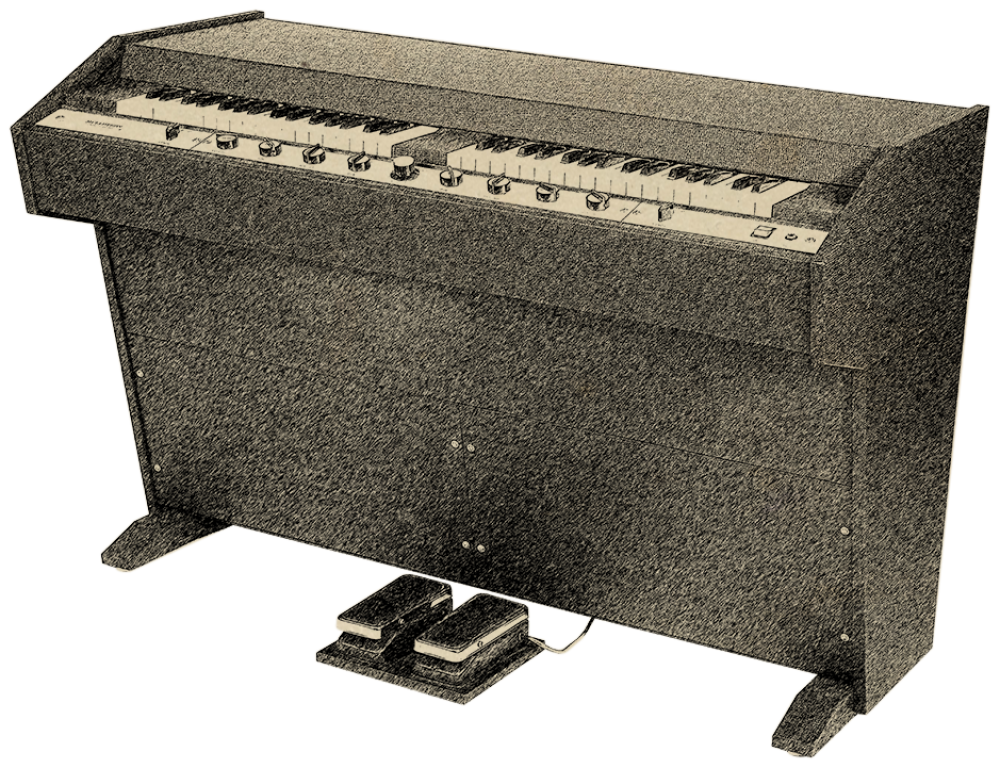
The Mellotron, taken from its original manual! There have since been many new iterations and revisions of the model, even software based versions…
Bulky, and constructed to resembled a piano - the Mellotron is in essence, the first sampler developed for musical use. Beforehand there are examples of tape recorders being used to capture and play back specific sounds, but the Mellotron was a first to take this methodology and launch it in the form of a fully fledged instrument (see the Chamberlain for it’s less commercial predecessor).
The Mellotron works by having the user depress a key which in turn draws a tape loop across a playback head (as would be the case in a tape machine), releasing the key causes the tape to once again return to its original position and away from the playback head. To clarify, if you are unfamiliar with the operation of magnetic tape, a playback head is simply a magnetic transducer that converts the stored information of a magnetic tape (e.g sound) into voltage, and then music once amplified.
You may not recognise the instrument visually, but you will have heard it in ‘Strawberry Fields Forever’ - it’s the first instrument you hear.
The flutes you hear during the opening of this track are from the library of the Mellotron, they are not ‘real’ in the sense of being recorded just for The Beatles and this track. Instead, the Mellotron offers a range of instruments (strings, brass, woodwinds) that can be loaded as tape for the performer to use. Not only does this allow a full command of orchestral instruments in the form of a keyboard interface, it saves the need to hire and record an orchestra. Obviously, this is controversial as an idea as it proposes putting the orchestra out of a job, and therefore it’s important to clarify that the Mellotron has a sound (and limitations) that in fact make it very different to the use of a real orchestra. Where a mechanical sampler (like this) offers the replacement of an instrument on paper, the actual sound produced is so unique that it instead steps aside as its own ‘instrument’. I think this is an important distinction in the use of sampling, and something I had initially not thought about back when I dismissed sampling. Because it enables a musician, already familiar with keys, to access a wider arrange of musical representations (in the form of instruments they may not play otherwise), it is in fact empowering. Suddenly, a musician can compose and write for instruments they would not understand otherwise but they can also introduce a new purposefully artificial sound to the studio.
Another characteristic quirk of the Mellotron comes about from its design. Remember how I mentioned tape? Well, there is a duration to notes played - too long and the loop runs out, causing a loud clunking noise and a brief delay while the tape reloads itself - not exactly musical.
To break up this text, here’s a delightful video of Paul demonstrating the instrument (sampler?)…
If you watch that video, you’ll notice Paul adjust the pitch and samples as he plays… all of which distorts and warps the sound in a way you could never do with a real orchestra. I think it’s this which really sets the art of sampling and samplers apart - they may possess characteristics or representations of other instruments, but their own unique quirks (whether mechanically or otherwise) offer their own impressionistic takes on the traditional sounds they may try to represent.
If you like the sound of the mellotron, you can find it all across the 1960s and 1970s, and even today it is often used as its own texture - it has become more of its own instrument than a sampler really.
1970s - 1980s: The First Official ‘Samplers’, Digital Technology, Staccato Strings…
By 1970, digital forms of sampling were beginning to be developed albeit not for commercial use. Around 1977/78, the Synclavier I was released (?) - I say released, only twenty were made and distributed to universities, so I’ll leave you to determine how far that definition stretches. Either way, this was one of the first commercial uses of digital sampling. Devised primarily with he architect of a synthesiser (through oscillators), a digital sample component was introduced to allow the Synclavier to better represents percussive sounds (requiring fast transients, that is - sharp, sudden sounds with lots of attack) which could then be modified through the tone shaping circuitry of the device.
The real digital heavyweight however, the CMI Fairlight, was introduced in 1979. Unlike the Synclavier’s synthesis-based architecture, the CMI Fairlight was in essence - a computer designed with musical functionality. Its creators, had originality sought to create a digital synthesiser during their teenage years but eventually found themselves disappointed with the sounds they could produce. This led them to prioritise a device which didn’t create sounds, but reproduced them (through samples), and so the Fairlight was born. On release, the Fairlight was incredibly expensive (tens of thousands of pounds), but offered musical possibilities that were previously unachievable. The device’s main limitation was its digital memory storage, which meant that only a select numbers of sounds could be storage and reproduced in their full fidelity or instead a compromise could be made by storing them in a lower resolution with the payoff being less realistic, aliased outputs. With its keyboard interface, it allowed for single samples to be played at any pitch. Since its introduction, many of its samples have become iconic - in particular, the cymbal crash (and staccato plucks) of the ‘Orch5’ sample. The sample specifically is taken from Stravinsky’s 1910 Firebird Suite.
You can hear the sample around 18 seconds into ‘Owner of a Lonely Heart’, by Yes, a song which deserves its own blog entry really… it’s an early example of production becoming an integral part of a song’s composition and success. Cheers Trevor…
Just as the Mellotron was adopted by the Beatles and then became a big part for the soundscapes of 70s progressive music, the Fairlight began to emerge in pop.
Speaking of prog music, with the abundance of Mellotron across Genesis’ discography, the Fairlight was first championed by Peter Gabriel for his solo albums. I recommend watching this demonstration by Peter Gabriel… it’s amusing.
The introduction of ‘San Jacinto’, one of my personal favourites, is populated by wide marimba patterns - you’d think they’re real, but no - that’s the Fairlight in use. The Fairlight was also used prominently across Peter Gabriel’s previous album (aptly named, Peter Gabriel 3), and though unsure - I wonder if it was responsible for the harsh glass sound that opens the track ‘Intruder’ - of course famous for the first use of gated reverb!
And on the topic of glass, you can find the Fairlight on Kate Bush’s ‘Babooshka’ for those glass smashes (see 2:30 or so, notice the low fidelity!) - I wonder if those samples are in fact the ones created by Gabriel in the video above… who knows. Beyond that, Bush adopted the Fairlight for future albums such as The Hounds of Love. In particular, the lengthy string sections of Cloudbusting were written using a Fairlight. For an artist like Bush, composing on the piano, you can see how the invention of the Fairlight was revolutionary for offering new musical directions when writing.
It would be hard not to mention the recent resurgence of ‘Running Up That Hill’ - you can find a Fairlight here too, it’s responsible for the continuous ambient pad that fills the song (most obvious in the intro), built from a sustained cello sample with a programmed pitch bend.
In my mind, the Fairlight is the next big step from the Mellotron for sampling, primarily for its ability to reshape samples whilst adjusting pitch. With a full set of ADSR capabilities - that is: attack, decay, sustain, release, the Fairlight is responsible for sound effects and other musical elements being reconfigured into new sounds, tailored for the canvas of an artist’s song. I suppose this is where musique concrète is allowed a little cheer, finally making its way into the mainstream music scene.
There is something wonderful about these major steps in musical technology, not for the raw appeal of their abilities or features, but the ways in which artists embrace, mis-use, and learn workarounds to all of the limitations and quirks of these devices. It’s innately exciting to think about a time where new devices or limitations allowed artists to create iconic sounds - I think it’s something we’ve lost nowadays.
One final thought - given the Fairlight’s limited memory (offering samples around one second long), it’s amusing to think that the device’s adoption into pop would have indirectly caused an increase in ‘staccato’ arrangements. I’m trying to imagine a version of ‘Cloudbusting’ that is legato, and away from the strident, marching pace that we are familiar with. Anyways…
Late 80s - 1990s: The Golden Age
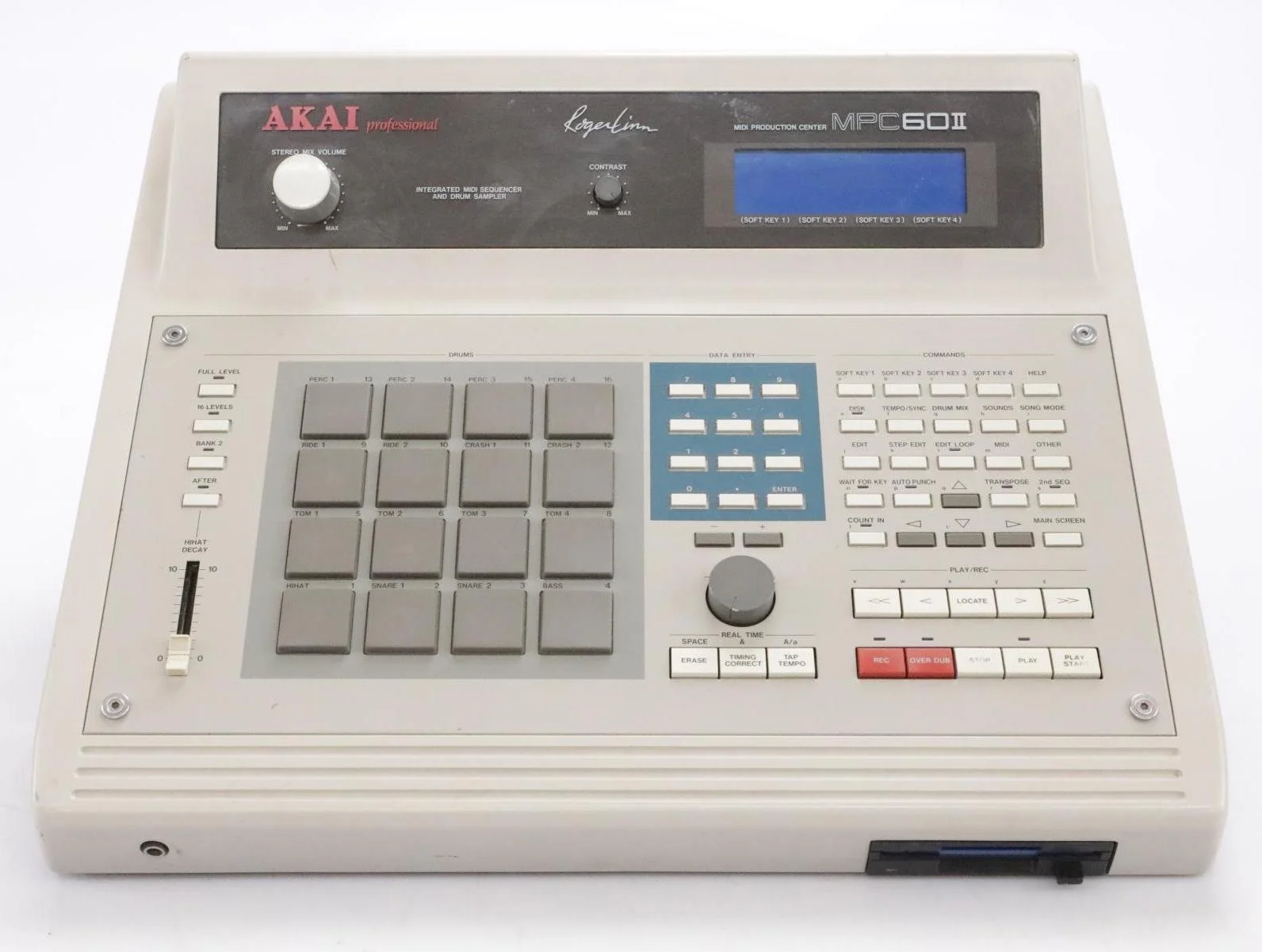
Akai MPC60II - 1991
By the late 1980s, digital technology had leaped forward and so had samplers. Come 1988, the Akai MPC was released, a sampler that coincided with (and directly influenced/propelled) the emergence of hip-hop and electronic music. Where the 1980s has become a decade made famous (and notorious) for (over)use of digital effects and technologies, it was becoming evident that there was a gap in the market between the previously expensive samplers (such as the Fairlight) and the increasingly popular but limited drum machines. Early hip-hop artists such as Beastie Boys (formed in 1979!!!) were increasingly moving toward sample based music but were limited by existing market solutions such as ‘grooveboxes’ - in essence, a middle ground between drum machines and samplers but that were expensive and time consuming to learn. Roger Linn, already famous for the Linn Drum, decided to develop the Akai MPC as a solution - a more affordable (still expensive!) device that would offer a simpler interface and a wider array of capabilities.
This resulted in a device that offered direct recording (to the device), sequencing, and a small form factor with simple rubber buttons for triggering samples. In the space of nearly a decade, samples could now be about 13 seconds long… which, musically speaking, could carry at least 2 bars, a significant jump. Despite this, it was the ability to slice and allocate parts of the same sample to these pads that made the devices so popular. Where the Fairlight was used for melodic composition, and sound effects, the Akai MPC became popular for its rhythmic capabilities - hence its association with hip-hop music. And so a list of musical revolutions:
Artists could now arrange, resequence, and perform drums without a drumkit, drummer, or with he preset/artifical sounds of drum machines.
Entire loops of drums, from other albums, could now be played and used as a basis of songs. Beyond this, entire passages of music could be used - hence, the birth of the breakbeat… or say, Portishead’s ‘Glory Box’, where an entire sample became the defining feature of a single, band, and genre - even outweighing its original recorded source.
The breakbeat - brought about from Jazz, google the ‘amen break’ and all will become clear…
Perhaps most importantly - the affordability, and intuitive interface, democratised the creation, recording, and performance of music. If the ability to make music is defined by one’s ear, and not their abilities on an instrument, these devices widened the appeal of music to those who did not know theory, how to record, or how to play instruments.
On that last point - DJ Shadow’s Endtroducing (1996) was the first album to be comprised entirely of samples. Built from vinyl samples, the album is an original work constructed from the original works of others…? Since release, the album has been cited as monumental both for the 1990s and modern music, with the techniques used to manipulate and re-represent samples into new musical forms become a lasting influence since. Where DJ Shadow found recognition in the U.K, following hip-hop’s growing popularity in the late 80s, the producer J Dilla became famous in the U.S for his ‘manual’ use of his MPC to create organic, mis-timed drum rhythms. By disabling the quantisation feature (which aligns samples to a set beat), Dilla found a way to humanise a digital instrument. Whereas I spoke of limitations inspiring artists to work harder, or more inventively, this marks a moment where a new feature is rejected in favour of a compromised solution. So, is it this need for a ‘drawback’ that really inspires the best use these devices?
My love of hip-hop, and trip-hop (more on that in a mo), is informed partly by the atmosphere of albums that surround it. Previously, I mentioned The Hounds of Love, an album that really is quite squeaky clean, and gloriously so! In contrast, the use of older vinyl recordings across the hip-hop/trip-hop albums of the 90s means that they are often marked by a signature lo-fidelity quality that adds its own charm.
I’ll use Psyence Fiction by Unkle as my example, even though it was released in 1998 - quite late into the ‘trip-hop’ period, it’s a great album filled with guest artists. If you take track 3 - ‘Bloodstain’, you’ll immediately notice the gritty atmosphere that pervades the song, creating a space before the vocalist enters. Beyond that, the slicing and rapid cuts across the drumkit offer a nice pull from the otherwise sedate, loose rhythms that underpin the song. For me, it’s a perfect meld of production and songwriting - where the sampler actually informs a good deal of the atmosphere and rhythmic content of the song while still allowing the artist to manipulate/adjust/change as they wish. Third then - the convertors and memory on these devices was still limited by today’s standards - the result, you’d lose a lot of treble from the samples due to a lack of digital bandwidth - literally, a lack of 1s and 0s to represent the upper frequency range of samples. Consequently, you get a ‘warm’ sound (that is, the impression of intimacy/bass weighted sounds) that again, really push into this idea of a sedate musical atmosphere.
In part, my fascination with Trip-Hop as a genre (see previous entry on Portishead), is that it originated from Bristol and is a genre that was born out (in part) out of the musical technologies that were used to populate the genre. There’s a symbiosis that exists between sampling and trip-hop’s presentation - the gritty, dark atmospheres found in the music, are in part because of the sampling technologies used. A good example is to listen to the early works of Massive Attack up until Mezzanine (1998), and then note the wider array of atmospheric palettes and moods present on that album.
Mezzanine offers the full circle of sampling - from the use of sound as texture, as defined by musique concréte, to the dub influences of the 60s/70s (inspired by music concréte), and then the new, gritty sounds of 90s sampling technologies.
Outside of the genre, sampling (and trip-hop) influenced the mainstream - famously, ‘Bittersweet Symphony’ was developed from an orchestral sample used in the 1965 Rolling Stones track, ‘The Last Time’. The result… widespread acclaim and success for the band, and a lawsuit which locked them out of any royalties.
So - sampling as a legal issue? Yeah, I suppose everyone was having too much fun. If you are familiar with De La Soul, which hopefully you are, you’ll know that their popular album - 3 Feet High and Rising - only made it on to streaming services in 2023 due to concern with the legality of the album’s samples. As much as sampling enabled collage to become a new approach to musical composition, it also introduced the need to ‘clear’ samples - that is, to verify and pay for the use of samples on a musical work. Without permission from right holders, artists would risk copyright infringement as well as access to royalties/earnings from their art.
The flip side to this, sort of - is the sampling trend of ‘cratedigging’. In essence, DJs and artists would spend time searching for obscure, or unknown vinyl albums in order to find new or unheard samples for their musical compositions. If you consider the risks associated with copyright and artistic license, it makes sense then that finding music that is either unknown or out of copyright, gives you a golden ticket for your creations…
Some common samples:
James Brown, ‘Funky Drummer’ - an artist sampled more than any other artist
The Amen Break, taken from ‘Amen, Brother’ (1969)
Led Zeppelin, ‘When the Levee Breaks’
Nowadays?
Unsurprisingly, and I suppose in my typical cynical fashion, sampling still exists today but much like most of music creation, it exists in the form of limitless potential. If you own any form of music software, there’s a good chance you can drag any sort of sample in you like, and cut it up with the tools there. Conversely, I still own a little black box over to my right - an Elektron Digitakt - maybe it’s just me, but I prefer something ‘real’ to work with. This device still has its limitations, but I can drag whatever samples I like in, and get them sequenced in about 5 minutes… from there I can experiment within a set array of parameters that keep me trying to experiment and think outside of the box. That being said, music is more democratic than ever - and I won’t criticise that.
So sampling - well, I think it took me a while to realise how important it was as a musical technique, as well as for inspiring a fair deal of the music I love. Nowadays I don’t believe that sampling is uninspired, or ‘stealing’, in fact - once you start using samples and arranging them, you realise it requires its own set of skills - you need good ears, a willingness to experiment, and the ability to mix and match sounds in a way that is sympathetic to the music you’re creating. It opens new directions for musical representation, and that can be achieved intentionally or by mistake - and there lies the joy.