In Celebration of James Gadson
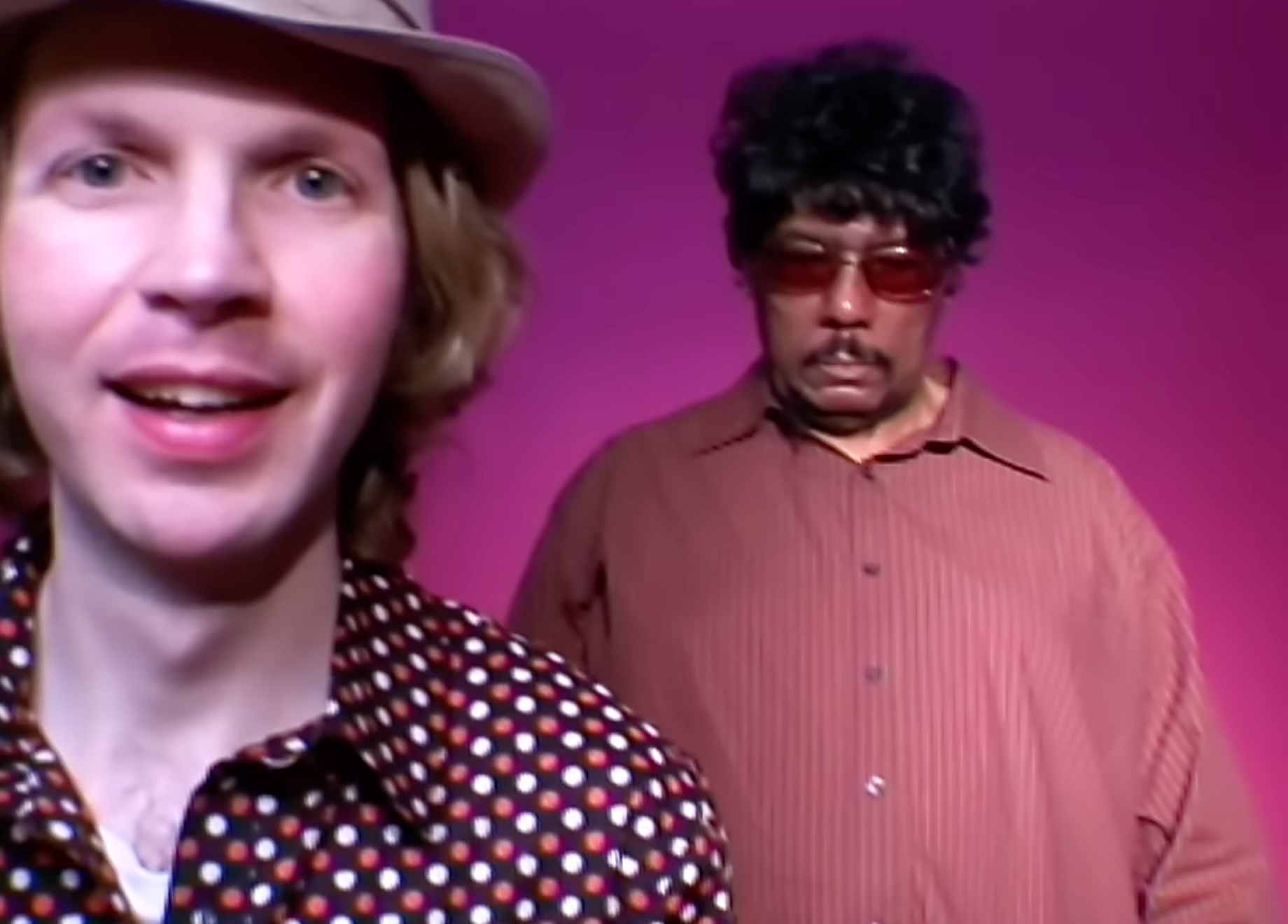
A Low Res grab from Beck’s ‘Think I’m in Love’ music video - my lasting image of Gadson!
A Solid Groove and a Hairpiece
I think I was about sixteen when I first saw Beck’s music video for ‘Think I’m in Love’, a purposefully low-budget projection that is largely Beck miming to the camera. In the same frame, James Gadson with signature hairpiece and chilled demeanour. Now, at the time, I had no clue who this guy was - in fact, I just presumed he was in frame to add to the comedy of the scene. How I was wrong!
In fact, beyond drumming for Beck, a quick google of James Gadson’s discography reveals the waterfall of famous albums he contributed drums to, including: Marvin Gaye, Bill Withers, Thelma Houston, Bobby Womack, The Supremes, and so on…
Really, Gadson’s drum work, starting in the late 60’s, spans all the way today - to artists such as Harry Styles. All of which is a testament to his character and attitude to drumming. I always think it’s a good sign when you find yourself hooked on a song, and wonder why, only to find that it’s actually the underlying groove or structure of the song that invisibly creeps into your mind - for me, that was Beck’s ‘Elevator Music’, a track with an intensely driving but funky rhythm section. Notably, the actual drum pattern barely changes, but it doesn’t necessarily need to given it anchors all of the lively effects and instruments that surround it.
I was saddened then, to hear this week of Gadson’s passing. He was 86 which is a good innings by any means, but it’s the knowledge that this quiet pillar of music history has passed which seems like such a shame. Unlike most artists, who tend to retire or create their best works early in their career, session musicians offer a much longer musical lifespan. Amidst the outpouring of tributes to Gadson, there was a common sentiment in the form of his character: keen to educate musical newcomers, keen to contribute to any artist’s music, and always preparing for the next gig. In particular, Beck’s tribute recounts a story where Gadson turned up for a session with a hospital wristband - he had escaped his recovery in order to be on time for drumming. Health concerns aside, I think that’s brilliant, a man who truly had a passion for his craft as well as gifting it to the music of others.
Often session musicians are presumed to be these elusive, god-like figures who appear in studios to nail a take in seconds and walk out again - often with a big lump sum. This is not untrue, but I do believe it shadows the other underlying strength of these individuals: they live for their craft. Yes, in the world of guitarists there is a widespread snobbery over who is the best, who was most innovate, how one person stole from another - so on. But, I think part of the mark of a session musician is their selfless contribution to the song itself, not the artist. They turn up, quickly identify with the song, and then try as best as possible to reinforce it in a complimentary manner - they’re individuals who really know music and how they can add to it without being seen. In the world of studio time, you get hired for your abilities yes - but more importantly, you get hired for your attitude. A decent player who’s a good hang beats a proficient ego any day.
For Gadson, this became clear - at least to me - as I read over his discography and slowly began to notice, ‘oh there he is again!’ as I’d listen to various artists I love. Frankly, he’s responsible for a big part of Motown, and beyond that - ‘Express Yourself’ - you know that song? You do. It’s one of the most sampled/referenced drum grooves going.
My Standout Picks…
My first pick is Bill Wither’s ‘Use Me’, from 1972 - about 4/5 years into Gadson’s recording career. For me, the track is defined by three parts: Wither’s voice, the clavinet, and the drums. I say this - there’s only 5 parts to this song, the aforementioned three instruments and then a bass and an acoustic guitar. In this case less is more, well - when used well.
Gadson’s drums stick to the same rhythm for the majority of the track but form the backbone of the song’s groove, and more widely - it’s pulling/pushing appeal. Regulated by Moeller-style 16th notes on the hi hat, the kick and snare continuously vie against one another to push and pull backwards across the track. If you listen, you’ll notice that the song drives forward and then takes a quick breather as the instruments and vocals pause - identified by a short passage of hat splashes. This short break makes the song - breaking up vocal phrases, and refreshing the more dense, main groove that pervades the song.
Note the chorus, just Wither's’ vocals and the drums, that pause gives you just enough time for your ears to be surprised again when the rest of the band comes back in. I think often people think a song needs to change completely by the chorus, or get bigger, but this track demonstrates how the opposite can work too. Very elegantly, taking these little breaks allows each instrument to go: ‘hey, check out what’s happening over here!’. In a way, it’s like a tutorial for your brain to notice how each musician is interacting with one another in a song’s rhythmic jigsaw.
Alright - so I’d be doing Gadson if I didn’t mention this track, the origin of his career and his first (and only?) band. If you need a quintessential track for the Gadson groove, this track has to be it - in his words, the blend of a Latin and Mississippi groove between the kick and snare.
I was going to make one of my usual snide remarks poking fun at the drum panning, a weird overhang of the 60s/70s, but it occurred to me that this might have been an indirect blessing for Gadson and for music generally. As weird as it is to hear a full kit panned left/right (they’re typically mono/centre - at least the kick and the snare), having the entire kit isolated on one channel (side/speaker) actually allows for very easy sampling because you can simply record the left side signal and then make it mono … and then voila, chuck it on any track you like.
Fast forward a little (a lot) - to 2014, ‘Sugah Daddy’ proves that Gadson’s groove is immortal really - at 75 years of age he lights the fuse on this track just as he did in the early 70s. Filled with swing and a tap-dance clapping rhythm (in the place of the hi-hat), this track feels effortlessly slick.
Oh and it has Pino Palladino… another legend, of the four stringed low-end. That is, the bass guitar… you know, four strings, not six. Behold as I transform into the grumpy balcony muppet! But, people should know the difference. Maybe not the most pressing of world matters right now though.
On this track you’ll notice the slow transition from a slow, smooth rhythm across the verses before Gadson throws in disco dynamite a little after the 2:30 mark. Suddenly, you’ve got a tight kick and snare stepping alongside the signature bounce of a souping hi hat that makes disco music so danceable. Then, in the final two minutes… fluttering ghost notes on the snare and a more hyperactive kick to really accentuate those bass octaves. Great stuff.
Gadson even made it onto a Paul McCartney record, I imagine because of producer Nigel Godrich’s request for McCartney to record the album solo, without his backing band - a bold ask that I think is in fact key for the album’s critical acclaim. Instead, there are select contributions from Beck’s touring band, fresh off the recording of Sea Change.
Gadson then, contributes drums to this track - which for me, is the standout track on the album. It’s quite rare to find McCartney releasing a song that pulls towards being downbeat, in fact, it’s his somewhat major temperament that has always pulled my ear closer to Lennon’s solo works (which are not without their own peculiarities - anyways… another time).
I chose this track because I think it showcases Gadson’s ability to occupy and serve a different musical space to the previous tracks - in fact, you might not notice that it’s him. He chooses to serve the song and its atmosphere - with a sparser choice of kick and snare, the hi-hat’s pulse becomes integral to the song’s rhythmic feel. As the song floats around the subject of romantic betrayal, the drums reinforce this slow but purposeful sense of mental plodding - a reflection of the song working out its demons. You could slow the drums, perhaps with an 8th or 4th pulse on the hats, but I think the choice of a more intense rhythmic pulse really helps to enhance the contrasting musical elements that permeate the song’s contemplative mood.
I leave this entry with ‘Paper Tiger’ from Beck’s Sea Change (2002). I’ve already written at length about this album so you can visit that for my thoughts… but those drums - wow.
This is the track I use to test headphones, speakers, studio spaces, mixes… for me, it’s a perfect track both from a musical and production point of view. Gadson’s drums are perfectly suited to locking the pace of the verses before then elevating the chorus and bridge with elegant, understated playing. The song is absolutely slick.
Production wise - the drums are recorded with the intimacy of 70s style drums, with little ambience and a light touch to allow for compression to fatten and shape each part of the kit. I’ve read people liken the sound to ‘cardboard’, in both a complimentary and derogatory manner… I like it. That’s me though!
Beyond the Kit
As a drummer, Gadson for me is a bit of a hero for his contributions to some of my favourite records as well as the techniques I’ve watched and tried to incorporate into my own drumming and recording. I think beyond that, I’m grateful for Gadson’s selfless character - whether to explain his own drumming techniques or approaches, or talk about the history of recording since the start of his career. If you watch any footage of Gadson, or read any tributes this week, you’ll notice people comment on Gadson’s positivity - both in the sense of enthusiasm when playing, but also in the form of his excitable, giggly character. I’d bet he’d be great fun in any studio environment - probably as a fantastic cure to any musical tension that could ever arise.
As a production nerd I love this video - but I think if you’re just into drums, or have a few minutes, it’s got entertainment value beyond its subject matter…