Less Conventional Recording: Re-Amping and Pedals
A shorter entry this week but one with more of a production focus. Notably, mixing and recording with pedals…
So, if you’re a guitarist, it’s quite likely that you’ll be familiar with the wide array of weird and wonderful little effects boxes that are available on the market. These trinkets often come with a single prescribed effect, sometimes with the adjacent belief that they may you play better (oh how we have all fallen for that one…), but often these little obscurities or niche tonalities can be really useful when mixing, especially to get unique flavours or sounds. So a little on how we might incorporate this process into a mixing or recording situation:
Re-amping 101
The first thing to consider is the types of signal that might be encountered when re-amping. Primarily, there are four forms of signal level that can be encountered:
Microphone Level - This is the weakest of the four, and put simply, is the voltage generated by a microphone when it converts acoustic energy into an electrical signal. It requires a pre-amplifier to be brought to line level.
Line Level - These are the highest level signals that exist before amplification (by a speaker system for example). They are the level of signals sent out of musical recording equipment.
Instrument Level - This falls between both mic and line level, it is louder than a microphone signal yet still requires its own amplification - hence why electric guitars are typically accompanied by an amplifier in a live/practice setting. Once again these require a pre-amplifier to reach line level.
Speaker Level - this won’t be spoken about today but it’s good to know about - this is the signal level that exists after amplification to feed a speaker. It is a much higher voltage than the aforementioned signals.
Hopefully that makes some sense - but a rule of thumb is that line level tends to exist outside of instruments, with the exception of synthesisers or drum machines. Typically line level is reserved for ‘professional’ recording and mixing equipment, such as that of an interface or mixing desk.
So why is this relevant? Well, when working with pedals we need a device known as a ‘re-amp’ box which allows for the line-level signal sent from a recording device (e.g an interface) down to an instrument level again for use with pedals or amplifiers.
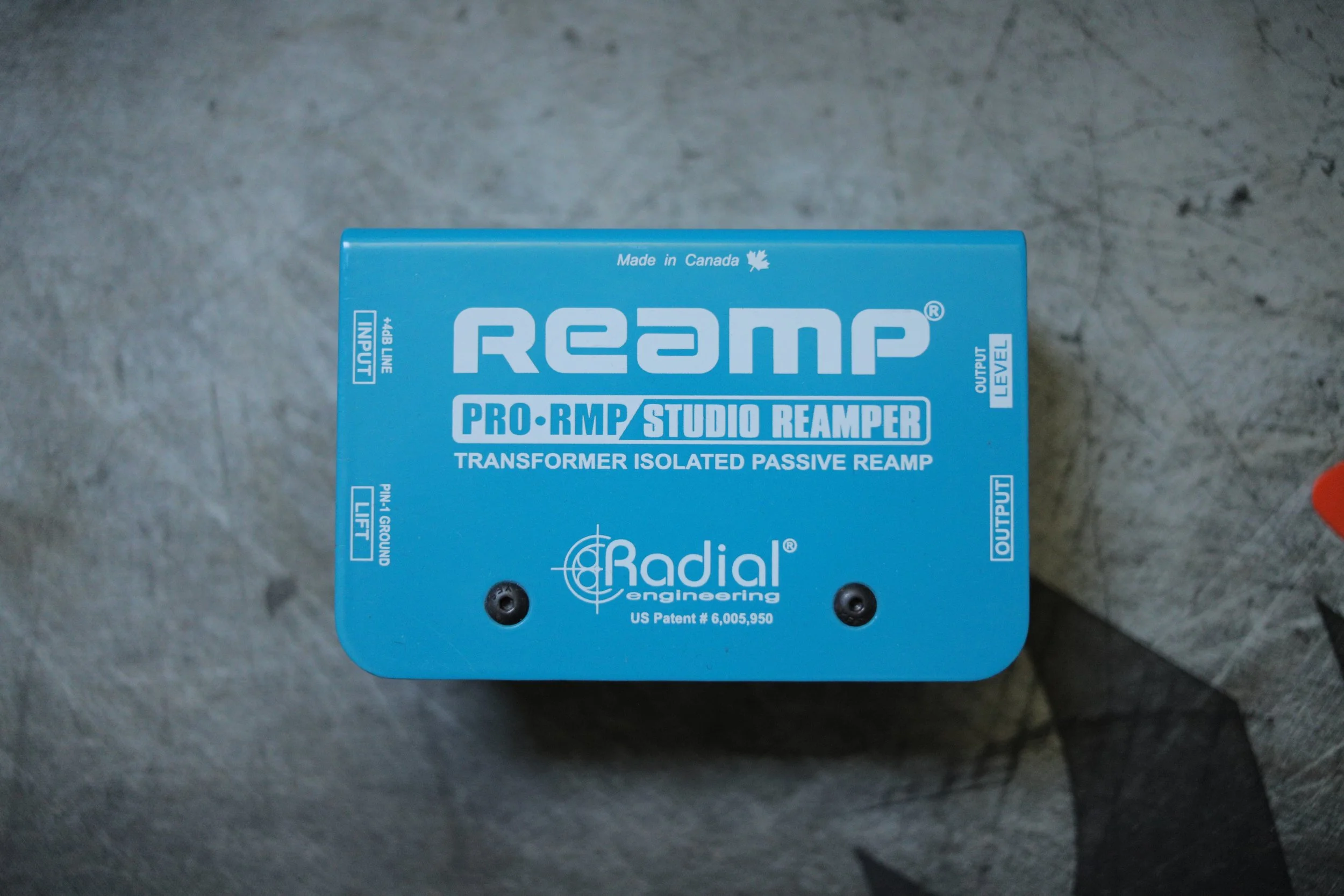
My Radial Re-amp Pro. You don’t necessarily need this one! They even offer a model that works from a headphone output - handy if your interface lacks line outputs.
From here, the rule of thumb is to route your audio from your DAW/Software via an output on your interface, through your pedals, and then once again back into your interface (if recording direct) or into an amplifier and a microphone. I’ve crudely drawn the signal flow here with an indication of associated signal levels with each stage:
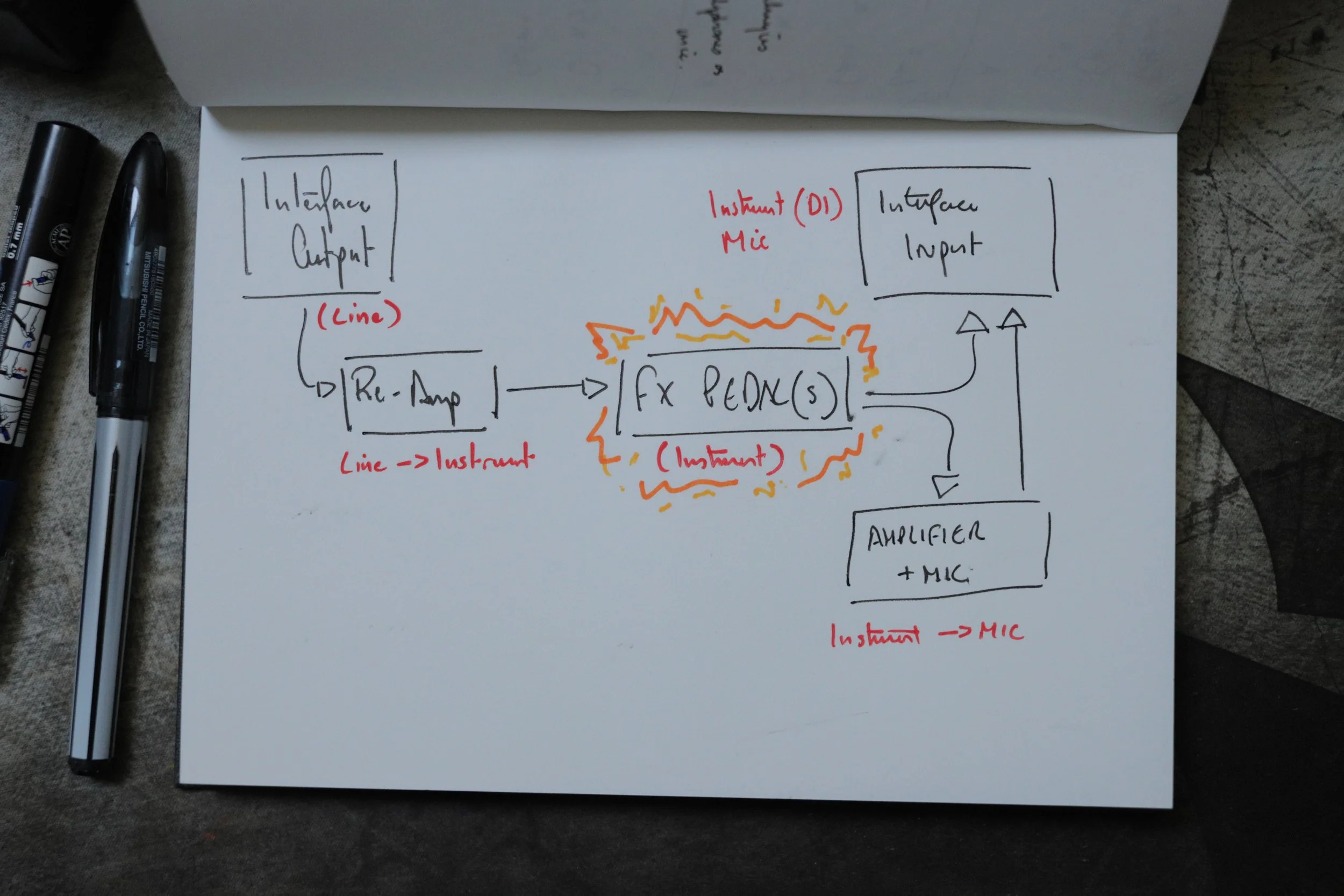
Routing the signals….
In my case, I routed my signal via Pro Tools as a send from the Line Outputs of my Universal Audio Apollo Quad interface, through to the Re-Amp, through the pedals, and direct back into the Interface’s instrument level inputs.
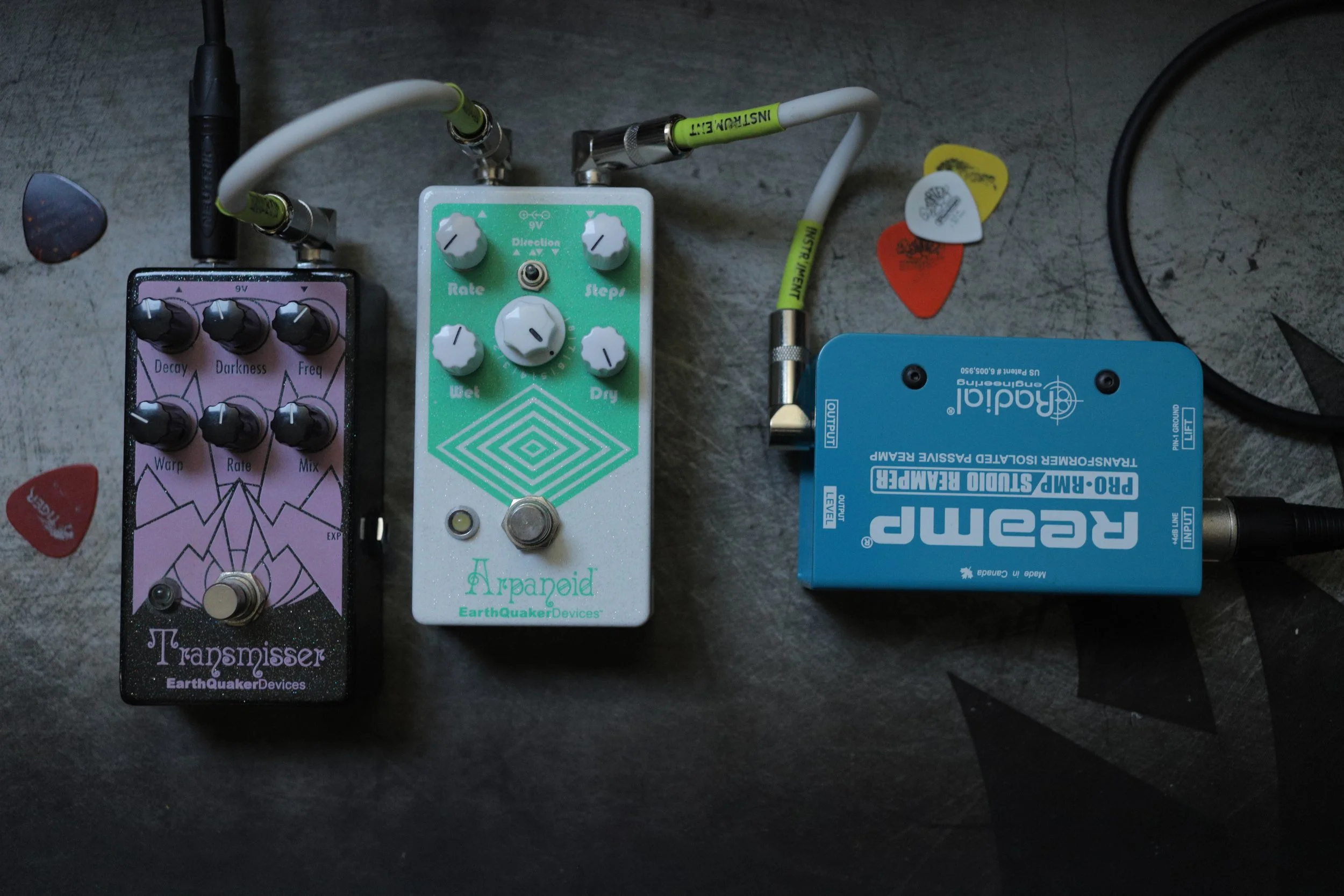
An example of the re-amp box connected to an Earthquaker Devices Arpanoid, and Transmitter pedal.
A Few Experiments
So here are a few examples of how you might go about using pedals on various sources, first piano, then drums, and then a guitar (well … sort of).
Want to skip these? Maybe just listen to the Piano’s Blackhole Example, or ‘Drums 2 Tape Delay’ - those are the best…
Piano
Pretty standard right? Just piano in a room. Here’s the same recording but sent through an H9 FX pedal with the ‘Tape Delay’ setting. The result is definitely unusual but adds a good deal of vibe and atmosphere.
Here’s another, this time with the Earthquaker ‘Transmitter’ pedal - an infinite delay that correlates with a pre-determined frequency. It’s really weird, and slightly spooky - sort of like something you’d hear in one of the Silent Hill games…
NB: A limitation here is that the piano is recorded in stereo, but consequently the mono nature of the pedal requires either two passes of recording, or to simply convert the piano also to mono (as in this example).
Final piano example then, the H9 ‘Blackhole’ preset, an infinite reverb that adds a lush, spacious effect to the piano - with its infinite decay the reverb almost behaves like its own instrument, layering on top.
Drums
Next up - drums - here’s a dry loop recorded straight from the kit.
The dry loop is a bit bland, so I used a spring reverb to add a little dimension to the snare.
Things get really cool with tape delay though…
Guitar/E-Bow
Another method I employed, was to use an E-Bow on a guitar to generate a single pitched drone, and then feed it through to the Earthquaker Arpanoid pedal. If by now you’re wondering what I'm on about - put simply the E-Bow is a device to infinite sustain a string through magnetic vibration (I think), and the ‘Arpanoid’ is a pedal designed to take a signal and repeatedly pitch it against musical scales. Frankly, it’s not that musical but I like the effect in its own right - it reminds me a little of the ZX Spectrum loop used at the end of Radiohead’s ‘Let Down’.
(I won’t include the original drone, as I’m presuming - dearest listener - that 10 seconds of C4 is not the best use of listening time.
Other Ideas and Uses
These examples only really scratch the surface of what’s possible - in no ways are you restricted to using just one pedal, or keeping the same settings, there’s always the chance to modulate settings or parameters or just use the pedals very briefly for select moments in a recording - it’s a can of worms once you get started. That being said, I do think these often can add fun to a recording session, or sometimes just add a bit of flavour to a source to give a track more personality/creative direction. I’m a big proponent of making decisions early during a recording session, as it saves any space for overthinking and forces you to trust in your creative decisions - so this can contribute massively to that. Commit to sounds early and use that to avoid decision paralysis.
You don’t even need to use pedals! Re-amping can extend to other uses, such as placing a guitar amplifier in a large space and using that (in conjunction with a mic) as a reverb chamber. Or, send the vocals straight through the amp - a la Julian Casablancas - for a sound similar to ‘The Strokes’.
Or stay in the box, and save yourself the bother - but where’s the fun in that?