Geese and the Return of From the Basement
I was delighted this week to see the return of Nigel Godrich’s From the Basement series. As any Radiohead fan worth their salt knows, From the Basement is responsible for some of the best raw, band focused live studio recordings going. Like most, my first exposure was to those fabled In Rainbows – era sessions, but I was quickly led on to watch the other videos and discover many of my favourite artists today. The original idea stemmed from older music shows of the 70s, such as Old Grey Whistle Test, with Godrich’s intention of capturing artists in a relaxed, pure studio format – no interviews, no comping of takes, no biased lens – just the music itself. For me, this gives a sort of timeless quality to the show, especially in a time now where music videos are less popular than they used to be and most content is consumed in small mobile formats on low budgets. Of course there’s nothing wrong with that, it’s wonderful to see how inventive artists are becoming with their self-promotion and I’m met with inspiring content with my fingertip. However, I do find it sad to think that often the larger corporations won’t dedicate more resources or budget to music-centric programmes. It feels almost as though the middle ground has fallen out a bit and I find myself mostly scavenging on YouTube at American radio channels. I know for sure that my own musical knowledge would be weaker if From the Basement didn’t exist – I can name several of my now favourite artists through the show, such as Squid, The Raconteurs, and Idles being most recent. All these artists have carved their own sonic niche, and so I know that whenever I watch an episode, I will be challenged in my listening and may not even immediately like what I hear. Anyways, I believe there’s a reasonable suspicion that should arise when a song is immediately enjoyable, and sometimes it is just a good song, but a lot of the time – as with albums – I eventually find myself in more of a love affair with the less immediate tracks.
So with that sentiment in mind – I think I’ve come full circle this week with my discovery of ‘Geese’, the next best big post-punk band to come on to the scene. A band which admittedly I was aware of back in 2023 (with 3D Country) but that wasn’t the right time for my then-unenlightened mind. My renaissance has since come about with the parade of music chatter about the new album, Getting Killed, cheery eh?
The opening track of the episode, ‘Trinidad’, is punctuated by disorderly Hendrix-style flourishes amidst ticking drums, ones which later explode to Cameron Winter’s almost jubilant yell: ‘there’s a bomb in my car!’. From that moment I was sold, and seemingly so was Nick Cave in this week’s Red Hand files, who extolled the universality of the opening lyric: ‘I try, I try, I try so hard’. I think it’s this juxtaposition between verse and chorus which had me listening to ‘Trinidad’ so many times over, before finally venturing into the rest of the set. It’s a song that starts in media res, with a tense atmosphere that continuously teases its chaotic payoff – or rather, the kind of song that puts all worry out of your mind at the start of your day – at least if you’re me. The subject matter – from what I can tell is a rebellion against mundanity, with metaphors of sensory deprivation in the face of everyday life: ‘when I went deaf / I used my eye / They stood me in line / Till I went blind / Get in Asshole, let’s drive’. In the face of dulling monotony, the chorus’ car speeds on as its own vehicle of personal liberation and into a cacophony of blaring guitars. It’s brilliant. On some level I wonder if the song’s sentiment is a wider reflection of the band’s image and experiences with recording – though maybe only coincidentally. Winter himself said in a recent interview with Rolling Stone that he ‘was unhappy until the last possible moment’, even having lost a day to finding a handclap sample amidst a library of thousands of files. While the latter part may sound comedically precise (trust me, it’s a real issue!) I think it reflects more widely on the fraught nature of writing, recording, and producing a full album as a band in the current day. I have seen interviews with Winter describing the way in which money disappears quickly over recording days, and having to continuously promote, perform, and evaluate a project during that becomes a herculean task. Thankfully the result is fantastic but that maybe doesn’t feel that way once a thousand people listen and try to pin it to every genre, texture, or style imaginable. I’m conscious I’m too participating in that… sorry Cameron. I digress.
In contrast to ‘Trinidad’, the next track ‘Husbands’ offers a slower pace with Americana lines layered over a walking drum rhythm section. I think the great focus here is Winter’s vocals, they’re raw and emotive, building and carrying the song as it details the disintegration of a dwindling relationship. This is partially in contrast to the denial of ‘Au Pays du Cocaine’ – the song title itself playing upon the projected paradise of Bruegel’s The Land of Cockaigne. Here Winter’s plaintive vocals repeatedly offer transformation and idealised scenarios as an alternative to reality, backed up by a lullaby of dreamy guitar lines and mellotron chorus. With their relaxed pace, these tracks feel as though they were drawn from a lost 60s album – I think it’s hard not to hear the influence of the Velvet Underground on these tracks, whether directly or spiritually. A win for me. Lyrically, I’m enamoured with the universality of the lyrics – repeated mantras such as ‘will you know what I mean?’ or ‘you can change’ all contribute to a bigger picture whilst seeming direct and every day. Actually, ‘you can change’ is pretty much the tragic mantra of denial that underpins ‘Au Pays du Cocaine’, as though repeating the phrase will instigate any real change for the song’s voice. I always think a song’s power lies in its ability to become personal to a listener and take on its own meaning – even if it wasn’t perhaps intended. I can’t think of many other formats where you can send someone a song to explain a feeling or mood.
There really is a wide range of influence across this set, and Geese’s music as a whole, with so many colours, structures, and images that keep me finding new musical relations across their songs, and in a way that’s a pleasant reminder rather than derivative. My thoughts immediately went to Can upon hearing ‘Islands of Men’, with its 70s Motorik rhythm underpinning the song. Likewise, the final track ‘Bow Down’ comes across as a gritty funk-oriented offering, riding the band out with an electric energy. Every song feels honest and natural in its construction, something with extends into the band’s live chemistry. The set is remarkably tight, it’s exciting to watch a band be in so sync with one another and it makes you wonder how the songs ever came from 30-minute jams once presented with the potent energy of the final tracks. On rewatch I’m amused by Dominic Digesu’s (bass) nonchalant look of approval around the one-minute mark and then the intense concentration between Winter and Emily Green at the beginning of ‘100 Horses’. All of this is underpinned by Max Bassin’s powerhouse drumming, and touring member Sam Revaz’ keyboard layers on top. If I haven’t praised enough – I’d end by saying that this episode of From the Basement encapsulates the joy of being in a band, or recording a band, or being in any musical space. It’s the small discrete moments of being totally immersed in a performance and locked in with fellow musicians that is one of the best feelings. Is it safe to say I’m a Geese convert?
You can watch the set here.
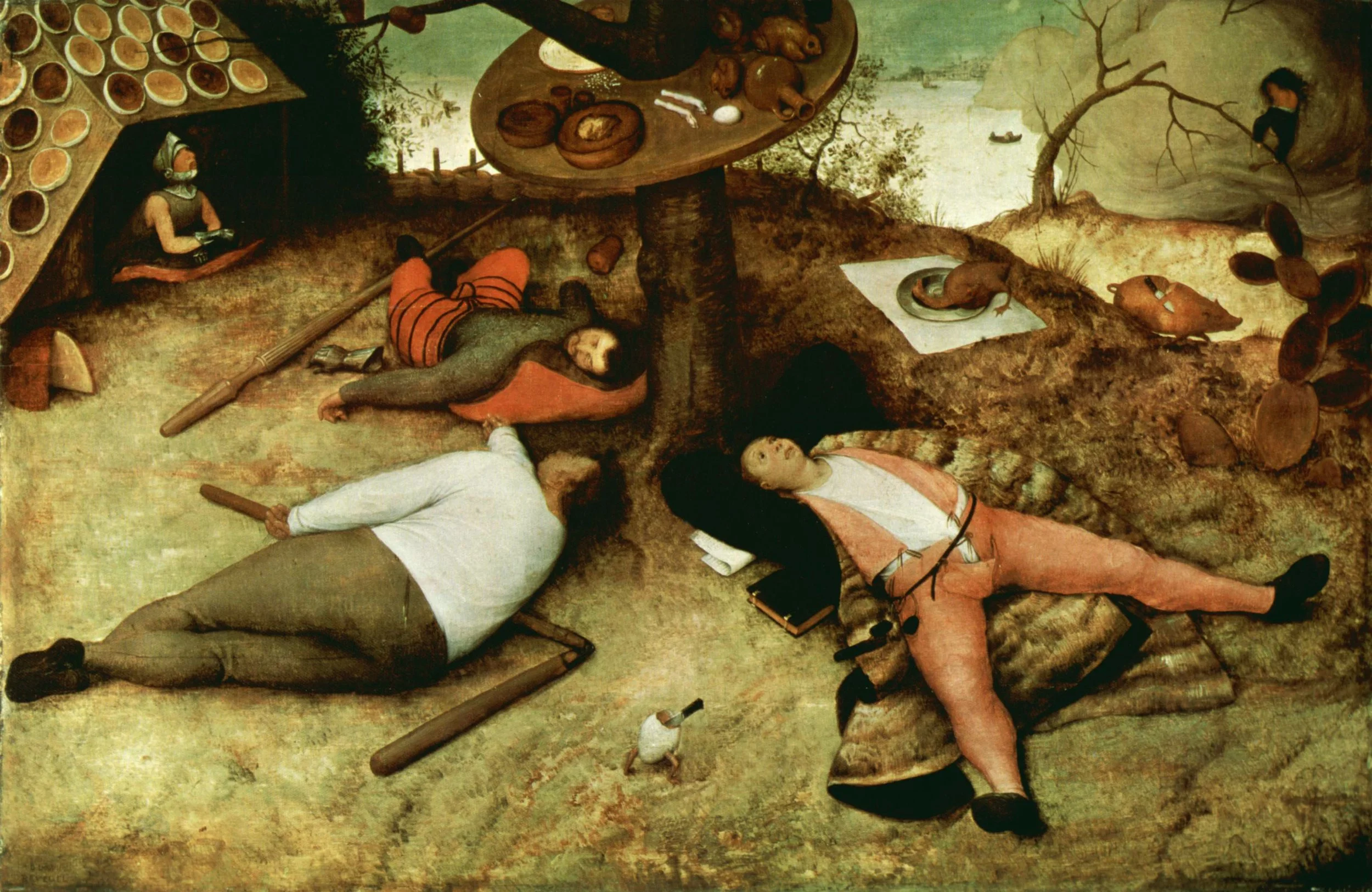
Pieter Brugel - The Land of Cockaigne