Beck’s ‘Sea Change’ - A Perfectly Produced Album?
Beck’s 2002 album, Sea Change, was admittedly the last of his discography I listened to fully and in fact dismissed at first (yes, this is a theme in my listening), and since has become my favourite of his by a mile, and easily one of my favourite albums of all time. I even had the fortune of seeing it performed live with an Orchestra at the Royal Albert Hall this year, which was as good as it sounds… expect lots of gushing to follow.
Notably the album was received with mixed reviews on release, with Rolling Stone awarding 5 stars but NME leaving the album at a 6.9/10. As a retrospective listener, I can see how this might have been informed by the sudden change in tone from Beck’s previous chameleon like approach to his music.
The album is different to much of Beck’s prior work and much more honest, especially when considering the pop-pastiche of Midnite Vultures (1999) which came before – an album that’s also great, but in so many different ways. It’s perhaps only with 2014’s Morning Phase then that there’s a retrospective link to the more introspective nature of Sea Change. I can only imagine many contemporary listeners would have been surprised by the serious, heartbroken Beck that now laid out his songs with a direct and emotional attitude. According to Beck: ‘I wanted economy in the lyrics and I wanted the songwriting to be very, very straightforward’. This is something I’ll discuss throughout, but for now I believe it’s a core component of the album’s emotive power. Unlike the sampled, energetic tracks found on previous releases like Odelay (1996), Sea Change draws from more folk and country influences to focus its subject matter.
From a recording point of view, the songs were largely drawn up as demos just a week before recording with the album being ready for mastering two weeks later. The studio of choice was Oceanway, with Nigel Godrich producing once again after previously working on Mutations (1998). According to bassist Justin Meldal Johnson, the tracks were mixed on the same day as recording, and onto tape: ‘I will confirm that the mixes on that album and Mutations before it were done largely on the small monitor section of the console, and rather quickly’. Personally, I think that is quite a feat of engineering given the mixing stage of an album can sometimes occur across a timespan of months. Moreover, the album was mostly recorded live in the room by the band, with minimal overdubs being reserved for bells or additional key sections. With that in mind, the result is phenomenal, the album has a natural and vast sound with a lovely HiFi sheen. I very rarely hear a similar quality on other records. I think it reminds me that the process of capturing good music doesn’t need to be complicated – sometimes it really is just talented individuals in a room captured with good recording fundamentals and a little technological glitter. The album is my go-to for testing new listening systems, and I think the drum sound on ‘Paper Tiger’ is the best I’ve heard.
Speaking of that song, ‘Paper Tiger’ is a song I would describe as classy. It opens with James Gadson’s drums and Beck’s plaintive, 3D vocals before developing into something much wider by the first chorus – a definite antithesis to the song’s opening simile:
‘Just like a paper tiger’
Immediately, J.M.J’s bassline springs into life to quicken the song’s pace as strings simmer in the background, climbing to a crescendo before dropping back into the calm of the verse. To me this song is perfect – everything locks beautifully and the build is such a wonderful pay off. Around halfway there is even an orchestral solo – I wasn’t aware those were allowed in the three minute ‘pop’ song but that’s cool right? I also suggest you go listen to Serge Gainsbourg’s ‘Melody’… there is a definite influence here!
In contrast to the swagger of ‘Paper Tiger’, the song’s emotional centrepiece – ‘Lonesome Tears’ lands directly into the desolate landscape of failed love:
‘How could this love / Ever changing / Never change the way I feel’
The lyrics abandon Gainsbourg for Hank Williams, employing simple, direct expressions complimented only by simple wordplay. Beck’s lyrics move into apathetic territory – tears that are beyond feeling to capture his overwhelm. Any spot of light quickly falls back on itself: ‘Lazy sun your eyes catch the light / With promises that might / Come true for a while’. The choruses swell into a dramatic orchestral wall, eventually being led into a lengthy bridge that features a soft synth – one that purportedly came from an early Pro Tools plugin (a refreshing change in the face of expensive studio equipment). During this bridge you start to wonder if there is a sense of light emerging, but instead the song is enveloped in a storm of further orchestral swells, this time modified by Godrich’s use of pitch-shifting delay (AMS DMX-1580S I believe, for you audio geeks out there) to create a stereo whirlwind. On top of this, the orchestra employs a Shepherd’s tone to give the impression of an ever-building pitch, stretching the song’s dramatic payoff further before eventually succumbing to the cacophony. It feels similar in scale to the Beatles ‘Day in a Life’, replacing lyrical overwhelm with sound.
The same despondency stems from the opening track ‘The Golden Age’, which once again belies its title. It’s a delicate, slow-paced track which I find a soothing escapism in, despite its sighing chorus:
‘These days I barely get by / I don’t even try’
The song’s composition matches its lyrical resignation with purposefully lackadaisical acoustic strums over atmospheric guitar slides and an emotive, descending glockenspiel. As an opener to the album, it feels like a late-night car drive under city lights, or a late-night walk – a solace without any real direction, just feelings. It sets a great precedent for the rest of the album’s tone. This leads into other songs such as ‘Guess I’m Doing Fine’ which offers a more typical set of country and folk tropes – calling upon muted birds and worn battlements to build an emotionally weighted track about being locked out from joy.
For me – I think ‘Lost Cause’ is perhaps the most pop-centric song of the album, moving away from a personal tone into a more universal break-up song. Despite that, it still features a good number of esoteric features – notably a harpsicord, mixed in amidst a flurry of backwards vocal loops. The structure is built simply around repeating A/B structures, but I think that’s it’s strength as a lighter track amidst the weight of surrounding tracks.
Side C begins with one of the few songs not written around the sessions, ‘It’s All in Your Mind’ dates back to 1993 in much the same form. It only came to be from Beck allegedly strumming it between a take and Godrich quickly becoming ecstatic. It’s another emotional sucker punch, reaching out to save someone from the distraction of their own mental troubles, perhaps futilely:
‘I wanted to be your good friend’
Another favourite of mine follows on, ‘Round the Bend’ opens quietly with cello in an ethereal canyon of sound – to my ear, a dark reimagining of Nick Drake’s ‘River Man’. I even wonder, with its wide cinematic strings, whether it could contend as a bond theme if reapproached with a faster tempo – but of course, I don’t want it to, the dramatic presence is glorious.
Amidst the wide landscape of strings, the song is composed very minimally without any percussion to punctuate it. The only sense of pulse comes from a distant acoustic, flitting between major and minor across the same C chord. Here, Beck really showcases his point about economic songwriting, with a deeply emotive song composed primarily around two elegant chords. I’m particularly fond of the orchestra’s migration from drone to melody around 4:15, it’s beautiful. In some ways it feels like a more mature evolution of Mutations’ ‘Nobody’s Fault But My Own’, moving on from a first-person perspective to an apathetic third person:
‘We don’t have to worry / Life goes where it does / Faster than a bullet / From an empty gun’.
Beck’s despondent voice resigns to the speed of life, assuming everything is fatalistic:
‘Loose change we could spend / Grinding down diamonds’
Everything that could be possible is still met with defeat. Much like the chords, the song seems to be perpetually caught in two minds without moving on. More deeply, Beck seems to be grappling with the way love can fail when there is no emotional reserves, even if the will persists.
‘People pushing harder / Up against themselves / Make their daggers sharper / Than their faces tell’
By the third verse Beck moves beyond a sense of ‘You’ or ‘I’ to cynically observe the ways individuals become cruel to one another, instead of moving towards reconciliation. All of this loops back to heartbreak in the final lines:
‘Babe, it’s your time now […] ‘Round, ‘round, ‘round the bend’
The song leaves you wanting to believe in a sense of moving on, optimistically, but there’s no guarantee it’s not met with more emotional apathy. It’s safe to say Beck is lacking much hope here. It’s moments like these that I find most fulfilling in lyrics, and songwriting – it’s the aporia of the drama – the sense of resolution but at a cost. It always feels like such an effective way to conclude a song whilst maintaining the dramatic complication of its subject matter.
Thankfully – there is finally a shade of light met in ‘Sunday Sun’, a song which opens yet another sonic room to the album. If the album begins at the somber night of ‘The Golden Age’, ‘Sunday Sun’ offers a psychedelic sunrise as an antidote. I think it’s most immediate intrigue is built upon it’s contrasting timbre to a lot of the less album: it’s the only track to feature a drum machine (a somewhat lovable, yet tepid CR78 – no disrespect!) underpinned by a tense leaning piano line. Finally, the fatalism of ‘Round the Bend’ is repurposed into acceptance:
‘There’s no other ending, Sunday Sun’.
Even if tinged with a sense of mania, the songs builds up and up into a new maelstrom of strident drum fills to crash (or park, less dramatically) the solo car ride found in the album’s opening. Such deranged hope feeds into ‘Little One’, the penultimate track of the album where the album’s title is derived: ‘In a sea change, nothing is safe’. Finally, ‘Side of the Road’ closes the album with a delicate, hushed acoustic track that parks the album’s opening. The distance has been covered, the weight is lifted, ‘let it pass on the side of the road’.
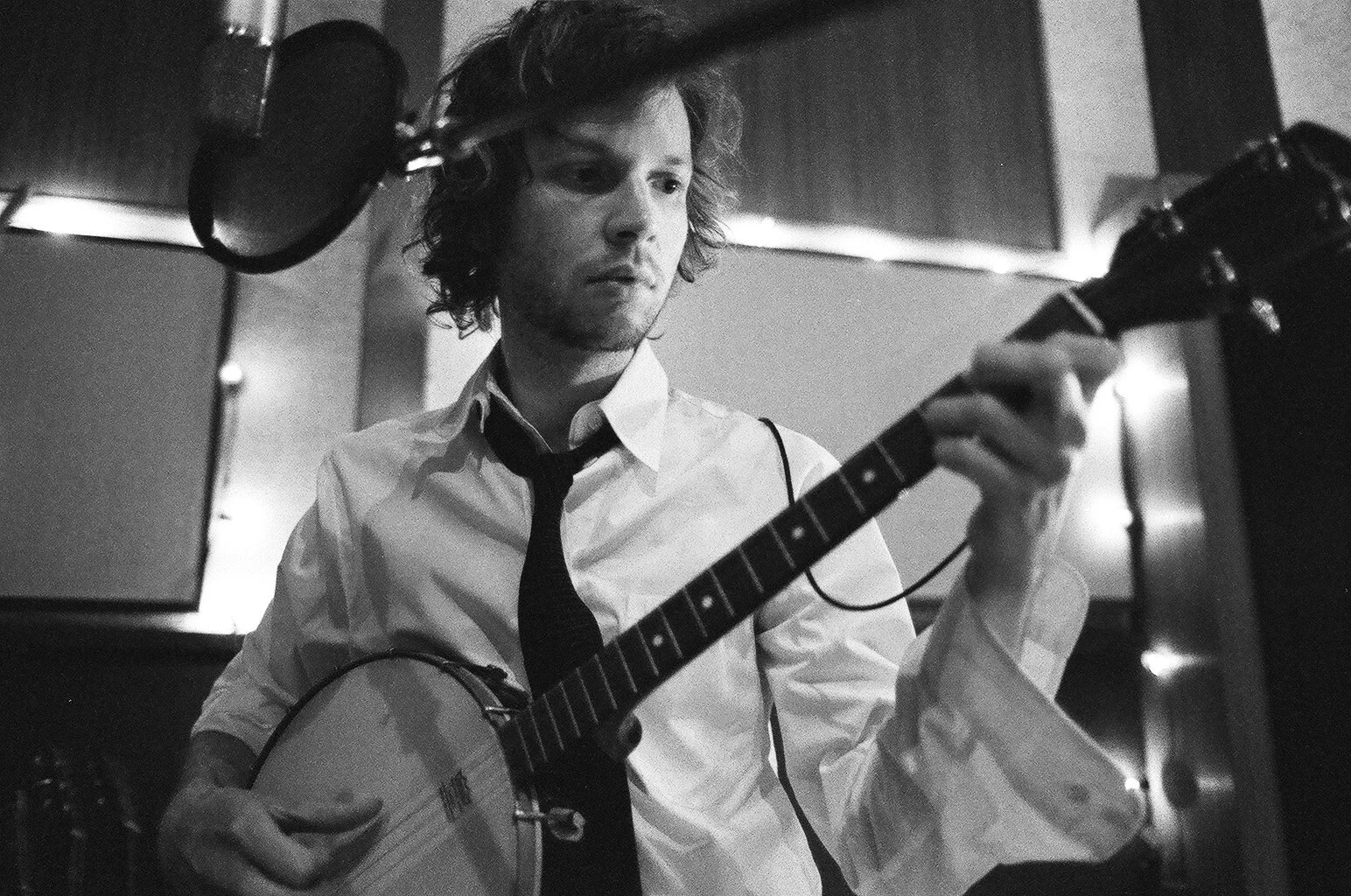
Sourced via Instagram: ‘Today Marks 20 Years of Sea Change’ - Beck, 24 September 2022